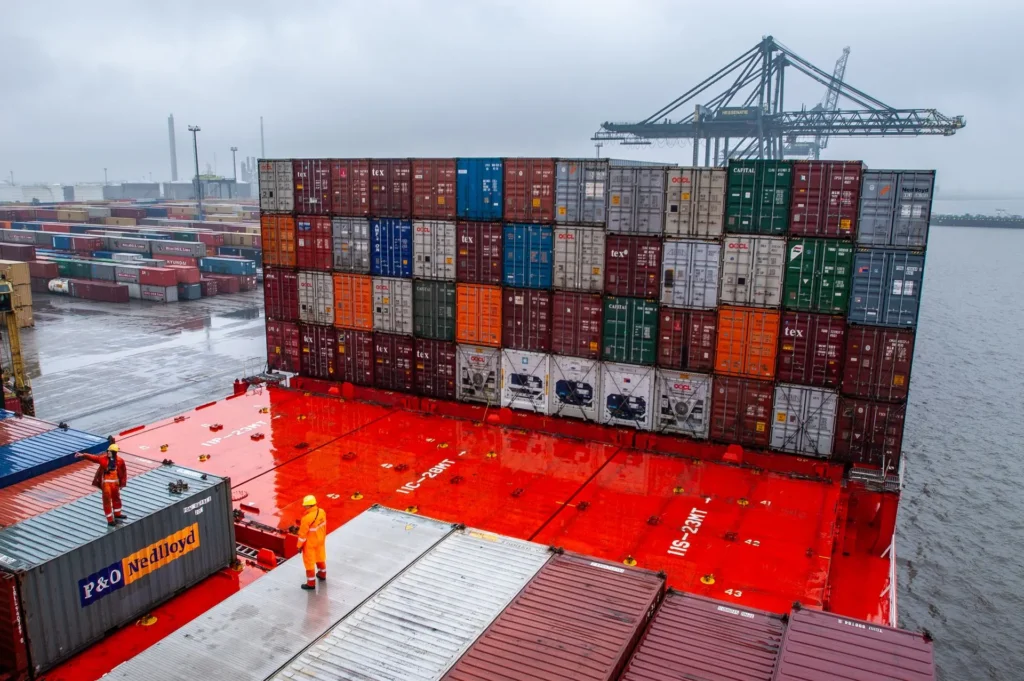
The risks most likely to trigger a global crisis — and the ones that hit logistics first — are starting to stack up. For supply chain teams, geopolitics and economic shocks sit at the top of the worry list, largely because the “uncertainty gap” is biggest there.
Research increasingly shows a tougher operating environment: less room for market-driven stability, fading optimism, and a growing belief that extreme volatility is simply the new normal. Even high-quality forecasts don’t offer much help when there’s no consistent set of assumptions behind them — and when those assumptions go out of date almost immediately.
Risk no. 1: geoeconomic confrontation
Not long after the World Economic Forum (WEF) published its assessment of the biggest threats for 2026, two of the most dangerous scenarios identified in the report began to play out around late winter and early spring — both with the potential to spark a severe, worldwide crisis.
In the WEF analysis, the single most-cited trigger was geoeconomic confrontation, named by 18 percent of the 1,300 experts surveyed from academia, business, and international organisations. The WEF describes this as the use of economic leverage to reshape economic ties between countries — by restricting flows of goods, services, technology, or know-how — with the aim of constraining geopolitical rivals, boosting self-sufficiency, or consolidating spheres of influence.
Risk no. 2: kinetic conflict
Close behind, 14 percent of experts pointed to interstate armed conflict as a likely catalyst for a major global crisis. The conflict in the Middle East that began on 28 February has quickly come to reflect both WEF threats — geoeconomic pressure and military confrontation.
On one side, Iran’s attacks on extraction infrastructure in the Persian Gulf and the blockade of the Strait of Hormuz have effectively put the global economy under pressure. On the other, what started as a limited kinetic conflict has already spilled into other countries in the region. Commodities markets felt the impact immediately, and the International Energy Agency has repeatedly warned that the world is experiencing the largest energy crisis in history.
A fast hit — and long tail — for logistics
The fallout hasn’t been limited to oil and gas. Transport markets worldwide have been shaken as well. As is typical after a commodity shock, freight rates, insurance, and fuel costs surged — with even the prospect of shortages in aviation.
The Strait of Hormuz blockade also forced a rapid redesign of global transport routes and left part of the commercial fleet effectively stuck in the Persian Gulf.
Project44 estimates that over nine weeks — from 2 March to 27 April — as many as 64,070 vessels were forced to reroute. Separately, comments made in April by the head of the IMO suggest that up to 1,600 ships and 20,000 seafarers may have been trapped in the Persian Gulf.
And it’s not only about LNG carriers, tankers, and their crews. In March, Sea-Intelligence analysts calculated that the ocean-going capacity scheduled to leave the Gulf — but unable to do so due to the closure — could total between 156,074 TEU and 204,159 TEU.
Roughly 2 to 3 percent of global container volumes normally pass through Hormuz. Once the regional port rotation fell apart, the effects quickly spread: ships and other cargo were diverted to ports elsewhere, creating congestion. In early May, transhipment containers in Mumbai waited an average of 15 days — an improvement on the 30-day average recorded in late April.
Disruptions are compounding
For transport and global supply chains, the consequences go far beyond congestion and rerouting. The final impact will depend heavily on how long the Middle East conflict lasts and whether the dual blockade of the Strait of Hormuz continues.
A separate concern is that major shocks are now arriving in clusters — and another logistics-linked trigger flagged by WEF experts could be next: extreme weather. Eight percent of respondents believe it could also set off a global crisis.
Risk no. 3: extreme weather events
In a May alert, NOAA (the US National Oceanic and Atmospheric Administration) said the probability of El Niño between May and July stands at 82 percent and is expected to rise through the end of the current year, reaching 96 percent between December and February.
El Niño is an ocean-driven weather anomaly marked by sustained higher surface temperatures in the equatorial Pacific. It reduces rainfall in Central America and can lower water levels — including in Gatún Lake, which feeds the locks of the Panama Canal.
The Panama Canal is one of the most critical arteries in global trade — and therefore in global logistics. Around 3 to 6 percent of seaborne trade passes through it, along with 40 percent of US container traffic valued at 270 billion US dollars annually. The El Niño-driven drought of 2023–2024 caused the most serious operational disruption in the canal’s history, forcing the authority to cut daily transits from 36–38 ships first to 24, and then — in February 2024 — to just 18.
Draft limits were also tightened from 50 feet to 44 feet, reducing the allowable cargo weight. As with Hormuz, prolonged restrictions rippled through supply chains, driving congestion, delays, rerouting, and higher freight rates.
The Suez Canal is still running at half capacity
When looking at geopolitical turbulence and the growing pile-up of disruptions on key routes, it’s also worth remembering that alongside the Strait of Hormuz — where traffic is currently only 5 to 10 percent of normal levels — and the elevated risk of constraints at the Panama Canal, the Suez Canal has not regained the throughput it had in 2023, when attacks by Yemen’s Houthi began.
Official canal reports show crossings falling from 26,434 in 2023 to 13,213 in 2024, then slipping again to 12,758 in 2025 — a drop of more than 50 percent in both cases. There has been no meaningful rebound in the first quarter of the current year: only 3,324 vessels used the corridor, down from 6,305 in the first quarter of 2023.
According to UNCTAD, the Suez Canal handles about 22 percent of global container volume and 40 percent of trade between Asia and Europe.
Supply chain leaders see the risks — and are benchmarking readiness
These are only fragments of a complex reality facing transport and logistics today, and there’s little to suggest a quick return to calmer conditions. Industry surveys and the views of logistics professionals point in the same direction: market conditions are tightening, pessimism is rising, and heightened geopolitical volatility — along with a general sense of uncertainty — is here to stay.
At the same time, many specialists appear to be identifying the right threats and building the ability to respond more flexibly.
In a Reuters Events analysis from last year on key risks to global supply chains, 74 percent of 450 logistics managers said geopolitical tensions create the most serious exposure — up from 33 percent in 2024. Regulatory change ranked second at 59 percent, a sharp jump from 8 percent a year earlier. Transport disruptions were cited by 38 percent.
Even so, respondents said their organisations are largely prepared for potential disruptions (40 percent), though only 5 percent described their readiness as comprehensive. In another similar study conducted with Maersk among 392 specialists in Europe, 90 percent said they could make appropriate decisions within a week when facing major shifts such as port closures or demand swings. Of those, 23 percent said they could respond within 24 hours, and another 26 percent within 48 hours. Expectations for the future were clear, however: 68 percent anticipate rising volatility.
What’s different this time?
Part of the answer comes from Blue Yonder’s Supply Chain Compass 2026 report, published in March. The survey covered 678 senior supply chain leaders at companies with annual revenues above 500 million US dollars in logistics, manufacturing, and retail, operating in North America and Europe, including Poland.
The outlook is still gloomy. Pessimists outnumber optimists, at 54 percent versus 46 percent.
Respondents believe the situation can be improved by focusing on the right strategic priorities. For 35 percent, that means boosting productivity and efficiency. Faster decision-making and improved profitability were each cited by 29 percent, followed by cost management (28 percent) and strengthening resilience to risks and challenges (24 percent).
Readiness to face disruption is improving
The study also asked leaders to rate their preparedness for major disruptions. Twelve percent said they are fully prepared — up by 4 percentage points compared with the same survey a year earlier. A further 45 percent said they can manage and recover effectively from unexpected, significant shocks. That adds up to 57 percent who believe they are ready to respond to major volatility in their supply chains.
Still, 42 percent either worry about resilience in the face of major disruption or have taken preventive steps but see clear room for improvement. One percent openly say they are unprepared and expect difficulty restoring operations after high-impact shocks.
– There’s no doubt the moment belongs to agile organisations that move fast and have efficient decision-making – says Magdalena Lubańska, 4PL Director at IDEO by ID Logistics, which provides transport services within a Control Tower model. – The past few years, with their intense market volatility, have shown that the ability to rapidly adjust operations to macroeconomic dynamics and disruption is now a source of competitive advantage.
In her view, the environment the logistics sector operates in will persist at least in the medium term, forcing greater flexibility from both operators and their customers.
– Deepening customer relationships will be crucial. From an operational resilience perspective, so will diversifying the industries we serve and maintaining balanced geographic exposure – she adds.
Although the company does not operate in especially geopolitically sensitive regions such as the Persian Gulf states, it still feels the knock-on effects of tensions there — which it monitors continuously, translating that analysis into decisions and practical adjustments.
– We are well positioned to sustain long-term growth, but we don’t ignore any threats — especially those with the potential to cause serious, long-lasting disruption for us and for our clients – says Magdalena Lubańska.
Where do logistics leaders see the biggest threats coming from?
For 68 percent of managers, the biggest danger lies in economic pressures, including inflation. Operational challenges — such as transport delays or inventory issues — come next at 60 percent. Slightly fewer, 59 percent, fear disruptions driven by geopolitics, including trade barriers. Even among managers who describe themselves as optimistic, concern about geopolitics remains high — 64 percent in that group still expect negative impacts.
Geopolitics also creates another problem: it takes the longest to interpret and respond. That widens the uncertainty gap — the time between identifying a threat and implementing a workable solution. While half of surveyed managers learn about geopolitical disruptions within 24 hours, only 20 percent can respond within a day.
For 43 percent, developing and rolling out a response takes up to a week, and for 38 percent it takes longer than a week. These disruptions tend to play out at a macro scale, with broader consequences that often demand structural adjustments.
A similar pattern appears with economic shocks: 44 percent hear about them within a day, but only 22 percent say they can develop and implement a solution within 24 hours.

High volatility and elevated risk are not going away
A broad risk diagnosis also appears in the Agility Emerging Markets Index published this year, based on input from 503 logistics executives and supply chain managers. One conclusion stands out: volatility is now widely seen as a permanent feature of the logistics landscape.
Nearly 86 percent agree. Within that group, 54.6 percent believe conditions in 2026 — at least in the short term — will worsen before stabilising. Another 31 percent expect no stabilisation at all and argue that today’s volatility should be accepted as the long-term reality.
When asked which risks their organisations are least prepared for, managers point to a familiar set. The top exposures include trade restrictions such as tariffs and protectionism (16.6 percent), economic pressures like inflation and rising costs, and labour shortages (both 13.1 percent). Supply chain disruptions rank high as well (12 percent), followed by an economic slowdown (8.1 percent).
Unsurprisingly, the leading priorities are building supply chain resilience (19.6 percent), protecting margins (19.5 percent), and sustaining growth (15 percent).
Why forecasts aren’t helping logistics
In its outlook for 2026, the WEF says plainly that uncertainty is the dominant theme. Experts surveyed by the forum take a negative view of both near- and long-term global prospects: 50 percent expect a turbulent environment over the next two years.
That rises to 57 percent when they look out over the next decade. Almost no one expects a spirit of political cooperation on global threats ten years from now — the expectation is the opposite. Respondents foresee protectionism, strategic industrial policy, and more active government involvement in critical supply chains, making the world even more competitive.
A multipolar or fragmented order — where mid-sized and major powers compete to set and enforce regional rules and norms — is the scenario envisioned by 68 percent. Another 14 percent expect a bipolar world shaped by strategic competition between two superpowers, and 12 percent anticipate a shift toward a new international order led by an alternative superpower.
Only 6 percent of the 1,300 respondents expect a revival of a rules-based international system led by the United States — a view that appears unlikely in light of remarks by the US Secretary of State more than a year ago, arguing that unipolar power was an anomaly produced by the Cold War.
Macroeconomic forecasts are expiring faster
Beyond their bleak tone, forecasts have another problem: they don’t stay valid for long. That was evident in the IMF’s April publication, which assumed a weaker global economy in every scenario — with the Middle East war listed as a major driver. Combined with high trade barriers and elevated international uncertainty, the conflict offsets positive forces such as investment in modern technologies.
In commentary accompanying its regular report, the IMF noted that because it is difficult to establish a coherent set of assumptions in real time, it published only a reference forecast — based on the assumption that the war would be limited in duration, intensity, and scale, and that the disruption it caused would ease by mid-2026.
Under that baseline, the average oil price for the current year was projected at 82 US dollars per barrel. Global growth in 2026 was expected to slow from 3.4 percent in 2025 to 3.1 percent, and then reach 3.2 percent in 2027 — below the 2000–2019 historical average of 3.7 percent. Core global inflation was projected to rise to 4.4 percent before easing to 3.7 percent.
But soon after the figures were published, it was acknowledged that the assumptions might already be outdated — something the IMF’s Managing Director confirmed in early May.
That leaves the adverse scenario in play: global GDP growth slows to 2.5 percent in the current year, inflation comes in at 5.4 percent, and the average oil price reaches 100 US dollars per barrel. The model also implies fertiliser costs are already 30 to 40 percent higher, which could lift food prices by 3 to 6 percent.
It’s also important to remember that economic and geopolitical volatility remains extremely high — and the IMF’s third, most severe scenario is still on the table. In that simulation, average oil reaches about 110 US dollars per barrel, GDP growth falls to around 1.8 percent in the current year and 2.2 percent the next, and global inflation jumps to 5.8 percent, climbing to 6.1 percent in 2027.
Overall, that would put the world on the edge of recession — something that has happened only four times since 1980, with the two most recent episodes coinciding with the global financial crisis and the COVID-19 pandemic.
Other major institutions are also warning about crisis risk
Whether the worst scenarios materialise will depend heavily on the Middle East conflict — including continued paralysis on key transport routes — but recession warnings are coming from elsewhere too.
Oxford Economics, for example, modelled a scenario in which the war keeps oil prices at an average of about 140 US dollars for two months. That, combined with knock-on effects, would tighten financial conditions, weaken business sentiment, and further intensify supply chain disruption.
That would be enough to push parts of the global economy into a mild recession. In that case, inflation would rise sharply to an average of 5.1 percent and peak at 5.8 percent. A significant increase in natural gas prices would follow, and these and other side effects would reduce global real GDP by 0.7 percent by the end of 2026.
Kpler reports that by mid-April 2026, supply interruptions and disruptions had already removed more than 500 million barrels of oil from the global market — described as the largest supply disruption in history. That also translates into roughly 50 billion US dollars in lost revenue from oil trade, comparable to the GDP of Latvia (48.59 billion) or Estonia (47 billion).
Another analysis, this time from Wood Mackenzie, suggests that 500 million barrels of unproduced oil is equivalent to a scenario where all road traffic worldwide stops for 11 days. Alternatively, it matches a 10-week reduction in global air transport demand, or a complete cut-off of the global economy from oil for five days.
That missing volume would also be enough to fuel the entire international shipping sector for around four months. Meanwhile, the effects of today’s disruptions may remain visible for many months — or even years — shaping not only energy markets and trade, but the logistics systems that keep them moving.