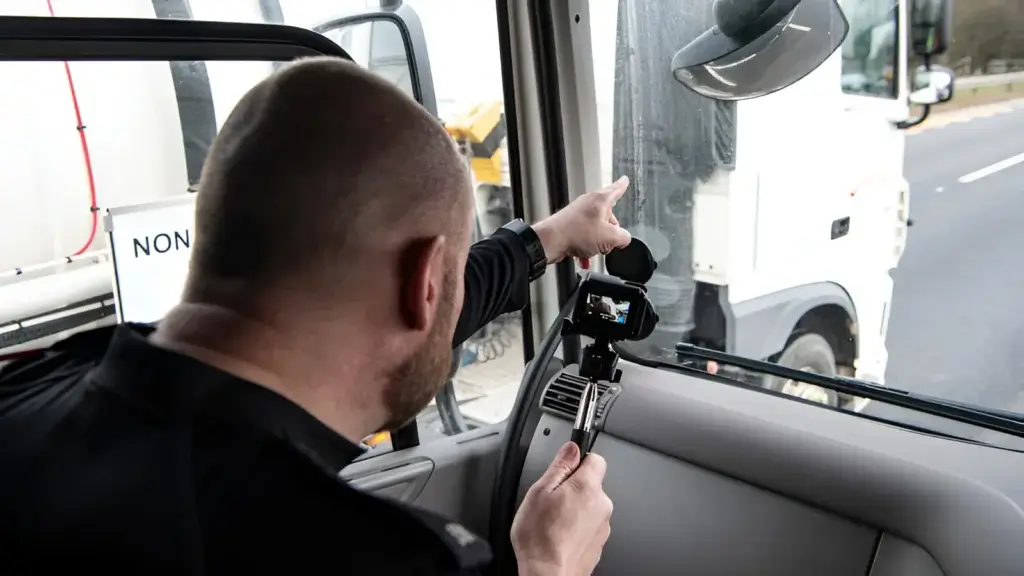
The checks were conducted from 13 to 17 July as part of Operation Tramline, a recurring road-policing campaign. Officers travelled in an unmarked HGV loaned by National Highways. The vehicle was not fitted with a speed limiter.
The elevated cab allowed officers to see into other vehicles and identify offences that might not have been visible from a conventional patrol car. They focused primarily on mobile phone use, failure to wear a seatbelt and other road traffic offences.
Phone obstructed HGV driver’s view
One HGV driver stopped on the M1 had positioned his phone in the centre of his field of vision, restricting his view of the road.
Sergeant Jim Carrington of the road policing unit said the driver could have failed to see another vehicle at a certain distance, particularly a motorcycle.
Because of the size and weight of HGVs, their drivers have a particular responsibility to remain focused on the road at all times,” he said.
More than 90 other drivers were also stopped during the five-day operation. A total of 38 were penalised for using a mobile phone at the wheel. Each received a £200 fine and six penalty points.
Police warn of fatal consequences
Sergeant Carrington said mobile phone use while driving was a significant cause of serious and fatal road collisions. The risks were particularly acute for HGVs because of their size, weight and the potential consequences of a collision.
The drivers using mobile phones at the wheel are now each counting the cost of putting other road users in danger for the sake of sending or receiving a message,” he said.
The officer added that he had attended several fatal collision scenes involving drivers who had been using mobile phones. Such incidents demonstrated why checks conducted from lorries were necessary, he said.
Operation Tramline is regularly conducted on British roads. Police officers use an HGV cab to observe and record offences from a position similar to that of other lorry drivers.
Cab clutter can also pose a danger
Police are increasingly using unmarked lorries to monitor drivers on motorways. From the elevated cab, officers can identify not only drivers holding phones or failing to wear seatbelts, but also less obvious hazards inside vehicles.
During a separate operation in the east of England, officers stopped an HGV in Suffolk whose cab was cluttered with rubbish and unsecured items. Police said the objects could have moved under the pedals, creating a risk that the driver might lose control of the vehicle.
The Suffolk Constabulary operation covered the A14, A12 and A11. Officers used an unmarked tractor unit loaned by National Highways.
During the four-day operation, 130 vehicles were checked, with officers recording an offence in every case. The vehicles stopped included 57 lorries, 36 light commercial vehicles and 34 cars.
Campervan checks in the Netherlands and Germany
The use of elevated vehicles for traffic enforcement is not limited to Britain. Police in the Netherlands also use vans, coaches and campervans to monitor drivers.
During one operation on the A7, A6, A28 and A32 motorways, officers patrolled the routes in a campervan. One officer observed drivers through a side window and alerted other patrols after seeing someone reach for a phone.
Police issued fines to 355 drivers in one day, including 104 lorry drivers.
A similar method was tested in Germany. In Bavaria, police officers monitored HGV drivers from a campervan before overtaking the vehicle and displaying the words “POLIZEI, STOP” on a rear LED panel.
A year-long pilot in Oldenburg, Lower Saxony, identified almost 1,700 cases of HGV drivers using mobile phones at the wheel. The results prompted local authorities to introduce permanent checks using unmarked vehicles.
The phone can wait
No call or message is more important than road safety. A lorry driver is responsible not only for the vehicle and its load, but also for the safety of other road users. When a vehicle combination weighs tens of tonnes, a few seconds of inattention can leave too little time or distance to brake safely.
Responsibility does not rest solely with the driver.
Hauliers and freight forwarders should organise communication in such a way that the employee does not feel pressured to answer calls or reply to messages immediately whilst driving. Contact with the driver should take place whilst stationary, and a delayed response must be treated as a sign of adherence to the rules, not as a lack of commitment,” Oksana Šukaitienė, communications and public relations specialist at the Lithuanian road carriers’ trade union, recently wrote in a guest article for Trans.INFO.
A phone in the cab can be a work tool, but it should take a back seat whilst driving. The safest message is one read whilst stationary. The delivery can arrive a few minutes later. Life and health lost due to a moment of distraction cannot be recovered.