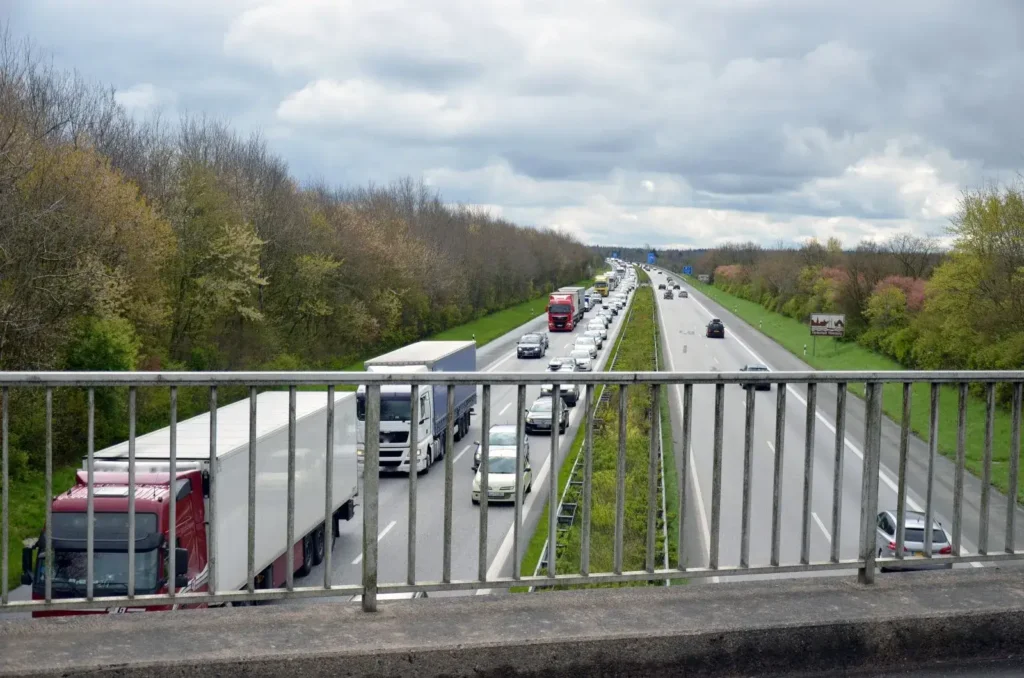
The rules will also apply to foreign operators, including Polish carriers. Failing to have the required service contract, operating with a faulty on-board unit (OBU) or using a transponder assigned to the wrong vehicle can trigger fines of up to €800. With the launch approaching, below is a practical FAQ to help operators avoid costly errors and roadside delays.
This is one of the biggest changes to Dutch road transport in years. Beyond the new charges, operators should expect additional administrative steps, new enforcement procedures and financial penalties. Dutch authorities have indicated the system will be enforced from day one.
How the Dutch toll works and where it applies
When does the new toll start in the Netherlands?
The new road-charging scheme takes effect on 1 July 2026. From that date, the Eurovignette will no longer be valid in the Netherlands. Charges will be based solely on the kilometres driven—similar to systems used, for example, in Belgium and Germany.
Which roads will be tolled?
Electronic tolling will cover:
- all Dutch motorways,
- selected national roads (N-roads),
- certain local and municipal sections near major cities.
In total, the tolled network will be around 3,000 km.
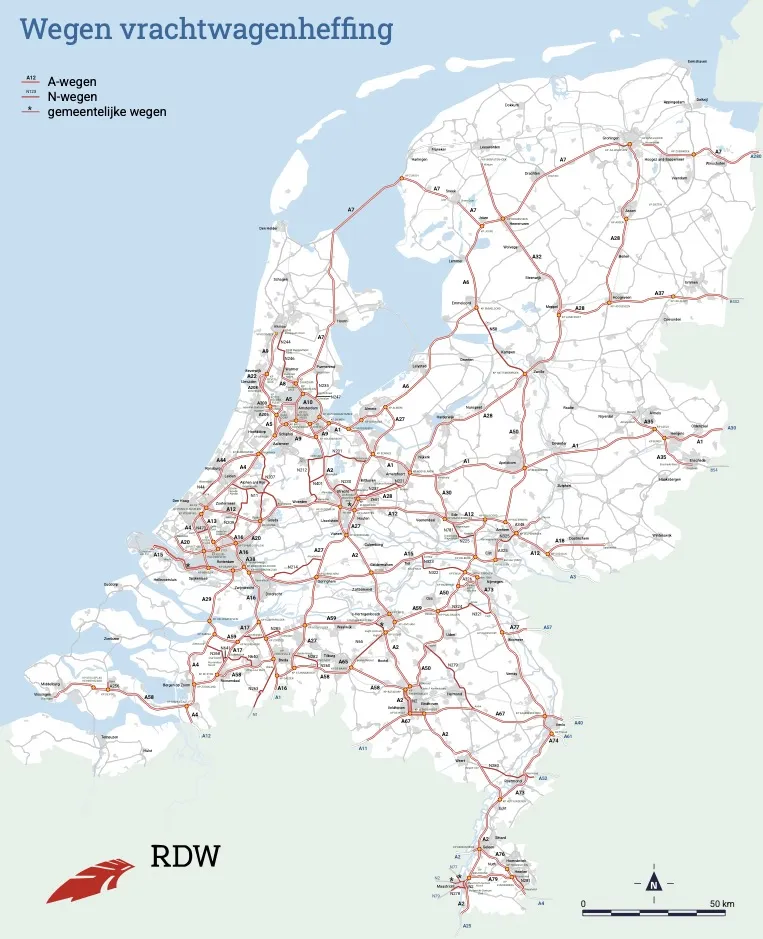
When planning routes, it is worth checking in advance which sections are tolled to price jobs accurately and avoid unexpected costs.
Which vehicles must pay? Pay attention to the weight threshold
Which vehicles fall under the new toll?
The per-kilometre fee will apply to all N2 and N3 vehicles whose technical maximum permissible mass is above 3.5 tonnes—regardless of where the vehicle is registered.
Why can some category B vans be included?
This is a key issue for operators running lighter fleets.
The Dutch vehicle authority RDW and the transport organisation TLN stress that what matters is the vehicle’s technical maximum mass (F1)—not an administratively reduced limit set to 3.5 tonnes.
So if a vehicle was built with a technical maximum above 3.5 tonnes, and later had its permitted mass reduced on paper to allow it to be driven with a category B licence, it will still be subject to the road charge.
This can affect, among others:
- larger box-body vehicles,
- refrigerated vans,
- vehicles with tail lifts,
- removals vans.
Are any vehicles exempt?
Yes. Exemptions apply to:
- vehicles using dealer plates or one-day plates,
- motor vehicles with restricted speed,
- waste collection trucks, street sweepers and sewer-cleaning vehicles with the required body markings,
- zero-emission delivery vehicles up to 4,250 kilograms,
- BE-type tractor units that fall under category N1.
Rates, CO2 classes and tax changes
How will the toll be calculated?
The charge will be based on two factors:
- the vehicle’s (or combination’s) technical maximum mass,
- its CO2 emissions class.
Four weight bands are planned:
- 3.5 to 12 tonnes,
- 12 to 18 tonnes,
- 18 to 32 tonnes,
- over 32 tonnes.
The average rate in 2026 is expected to be 19.1 euro cents per kilometre.
Examples:
- a Euro 6 vehicle over 32 tonnes: around 20.1 euro cents per kilometre,
- a comparable zero-emission vehicle: around 3.8 euro cents per kilometre,
- a Euro 6 vehicle in the 3.5–12 tonne band: around 11 euro cents per kilometre.
How is the CO2 class determined?
The classification follows these rules:
- vehicles first registered before 1 July 2019 are automatically placed in CO2 class 1,
- fully zero-emission vehicles receive CO2 class 5,
- all other vehicles are classified based on data found, among other sources, in the Certificate of Conformity (CoC) and the vehicle’s documentation.
Important catch: the CO2 class is not permanent
TLN highlights two points operators should not overlook.
First, the emissions class is valid only for six years from the vehicle’s first registration date. After that, the vehicle must be reclassified.
Second, in the Dutch system the reference year runs from 1 July to 30 June. That means two almost identical vehicles registered in June and July of the same calendar year can end up with different reference values.
Where can you check the assigned emissions class?
You can verify this before entering the Netherlands. The information is available in the RDW vehicle register. Emissions data can be found under “Engine and environment”, then “Emissions”.
TLN warns that thousands of vehicles may have an incorrect CO2 class assigned, so it is worth checking the data before the system goes live.
What happens to the road tax and the Eurovignette?
From 1 July 2026:
- the motor vehicle tax for trucks up to 12 tonnes will be fully abolished,
- for vehicles over 12 tonnes, the motor vehicle tax will be temporarily reduced to a zero rate until 1 January 2027.
If a carrier holds an annual Eurovignette that extends beyond 1 July 2026, it must request a refund for the unused period. The refund will not be issued automatically.
What will the toll revenues be used for?
Net revenues are to be reinvested into the transport and logistics sector, especially in:
- transport electrification,
- hydrogen technologies,
- support and grant programmes for carriers.
However, support will not be paid out automatically—operators will need to submit the relevant applications.
OBU requirements and choosing a provider
Do you need an OBU installed?
Yes. The Dutch system is satellite-based. Every vehicle subject to the toll must have an active on-board unit (OBU) that records kilometres driven.
The device must remain switched on for the entire time the vehicle is in the Netherlands—even when travelling on roads that are not subject to the charge.
Where do you sign the required contract?
Carriers can choose between two options.
NedLinq
This is the state-appointed service provider designated by the Dutch government. It must accept every customer, but its devices work only within the Netherlands.
EETS providers
These are operators offering devices that also work in other European countries.
Accredited providers already include:
- Telepass,
- TotalEnergies,
- Eurowag,
- Axxes,
- tolltickets.
Enforcement and penalties
What fines apply for non-compliance?
The following penalties are set out:
- €800 for not having a valid contract with a service provider,
- €500 for driving with the OBU switched off,
- €500 for driving with a malfunctioning OBU,
- €500 for using a device assigned to another vehicle.
Transition period: reduced fines for the first six months
A transition period runs from 1 July 2026 to 1 January 2027. During this time, all the penalties listed above will be automatically cut by 50%.
In practice, that means:
- €400 for no contract,
- €250 for OBU-related violations.
Can you receive multiple fines in a single day?
No. Within a 24-hour period, only one administrative penalty can be issued per vehicle. If several violations are detected at the same time, the authorities will apply the highest applicable sanction.
How will checks be carried out?
RDW is responsible for oversight, while inspections will be carried out by the Human Environment and Transport Inspectorate (ILT).
Enforcement will use:
- gantries equipped with ANPR cameras,
- DSRC systems,
- mobile inspection patrols.
Will foreign carriers be fined too?
Yes. The rules apply to both domestic and international operators. Using EUCARIS, Dutch authorities will be able to access vehicle-owner data from national registers in EU member states, and fines can be sent outside the Netherlands.
Can Dutch inspectors immobilise a truck?
Yes. If a vehicle is detected on the road without the required charges paid, or with outstanding amounts due, its registration number may be added to a special alert list.
During a roadside check, the driver may be required to pay immediately. If payment is refused or not possible, inspectors can apply temporary measures, including immobilising the vehicle until the penalty is settled.
What to do before 1 July
Before the system starts, operators should:
- confirm the CO2 class for every vehicle,
- check vehicle details in the RDW register,
- choose a toll service provider,
- order and activate OBUs,
- assess how the new charges will affect transport costs,
- discuss any necessary rate adjustments with customers.
With the start date approaching, missing contracts or an OBU that is not working properly can result in fines and, in some cases, a vehicle being held during a roadside inspection.