
Key takeaways
- Scania’s Super 11 fills the gap between the existing 9-litre and 13-litre engines.
- It weighs around 100 kg less than the Super 13 and about 10 kg more than the 9-litre engine.
- Depending on the job, Scania says operators can expect fuel savings of 5% to 10%.
- Variable valve timing, turbo dosing and fuel skewing appear in this engine class in this combination for the first time.
- A stronger engine brake can remove the need for a retarder in certain applications, saving roughly another 100 kg.
- The platform was engineered with future Euro 7 requirements in mind.
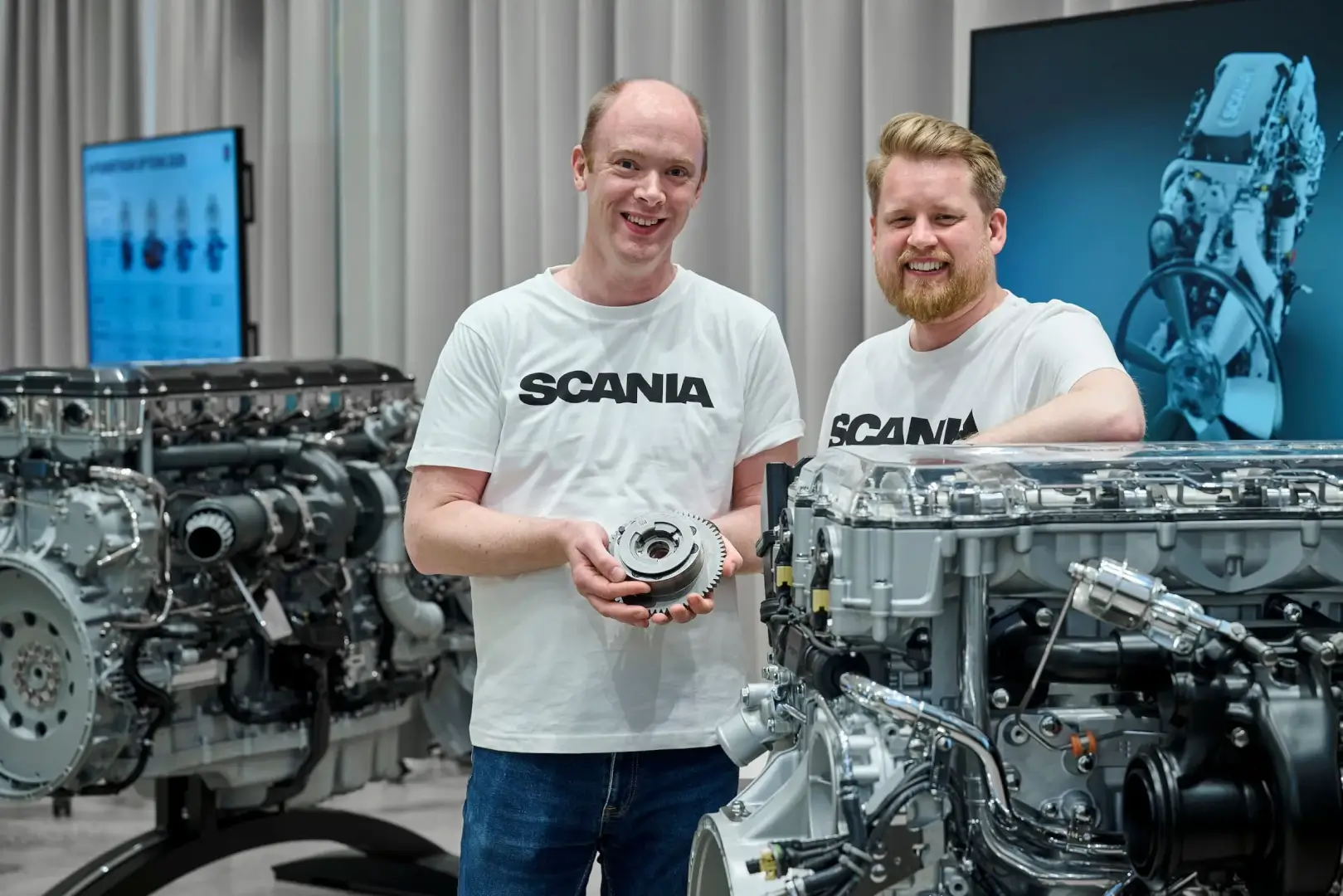
At a pre-series event for international trade media in Södertälje, Scania again highlighted its Super 11. The engine was unveiled last year, but the company used the occasion to underline its role within the powertrain line-up.
Scania is positioning the Super 11 as a way to improve payload, fuel consumption and total operating costs in a market that will continue to rely heavily on combustion engines in the near term.
Positioned between 9- and 13-litre engines
With the Super 11, Scania broadens its engine range across 7-, 9-, 11-, 13- and 16-litre options. The aim is straightforward: to offer a better fit for operators who previously had to choose between the 9-litre and the larger 13-litre.
The new inline-six shares its base platform with the Super 13, but with one cylinder removed.
According to Scania, this makes it almost 100 kg lighter than the 13-litre engine, while delivering notably more power and torque than the 9-litre alternative. Compared with the smaller engine, the weight difference is around 10 kg.
For fleets, the result is more flexibility when specifying vehicles.
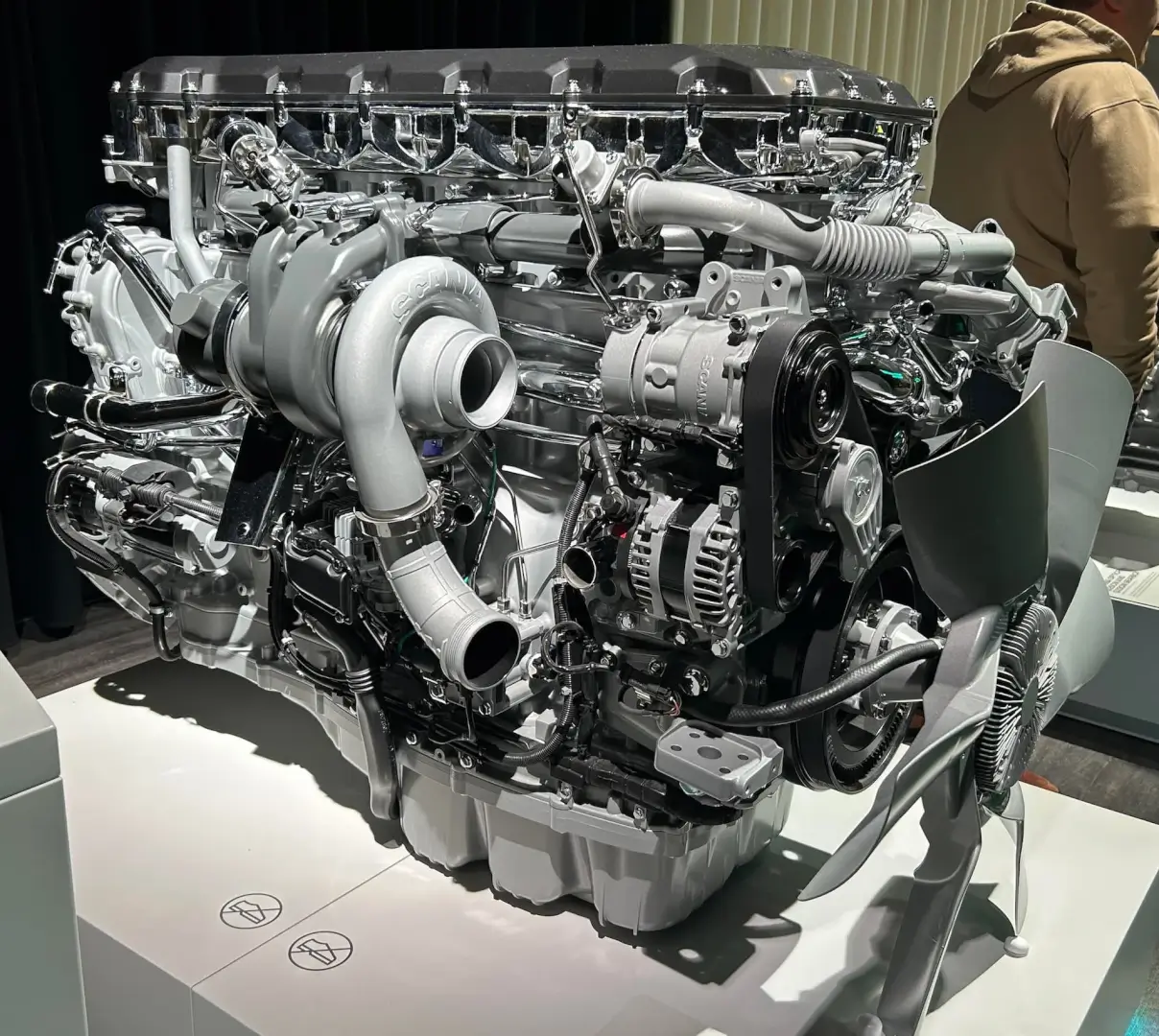
Photo: trans.info
Up to 200 kg of additional payload potential
Weight is where the Super 11 may be most relevant for many operators.
Beyond the lighter engine, Scania points to a more capable engine brake. On combinations up to roughly 32 tonnes gross vehicle weight (GVW), this can mean a retarder is no longer required in many cases.
Scania’s calculation is:
- around 100 kg saved through the engine itself,
- plus roughly 100 kg if the retarder can be omitted.
In total, this adds up to about 200 kg of additional payload potential.
In tanker and silo operations, construction transport or municipal duty cycles, that can be financially more significant than marginal gains in power output.
Three technologies behind the efficiency gains
The biggest changes are inside the engine. Scania has combined several features in the Super 11 that, in this configuration, have not previously been offered in this engine class.
Variable valve timing
Using cam phasers, the engine can adjust camshaft timing dynamically, enabling more precise control of combustion. Scania says it also removed some external components previously required, including the exhaust brake throttle and parts of the exhaust gas recirculation system.
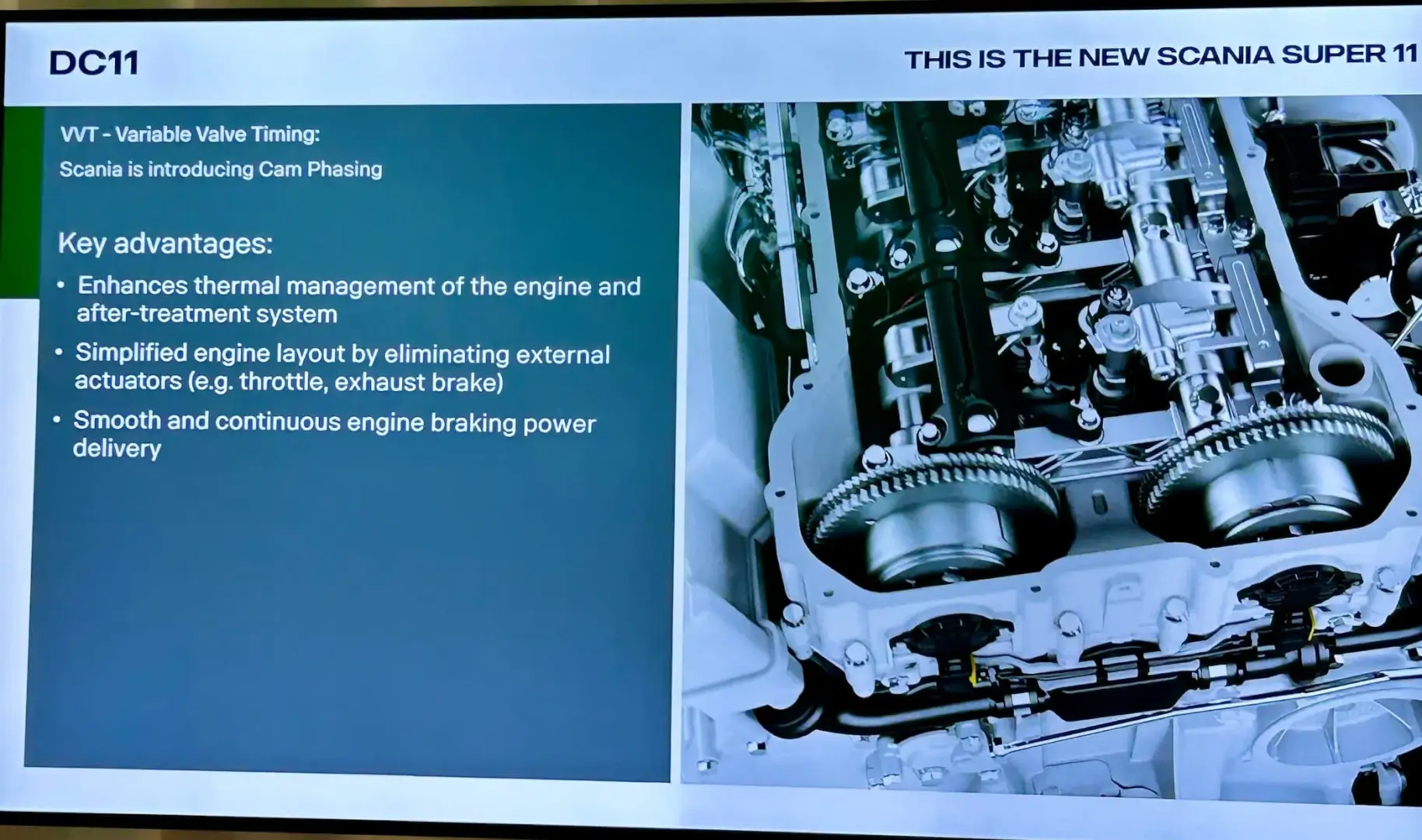
Photo: trans.info
The aim is more efficient combustion and improved control of engine temperature.
Turbo dosing
Another change targets aftertreatment. Instead of dosing AdBlue further downstream in the exhaust system, the first injection now takes place at the turbocharger.
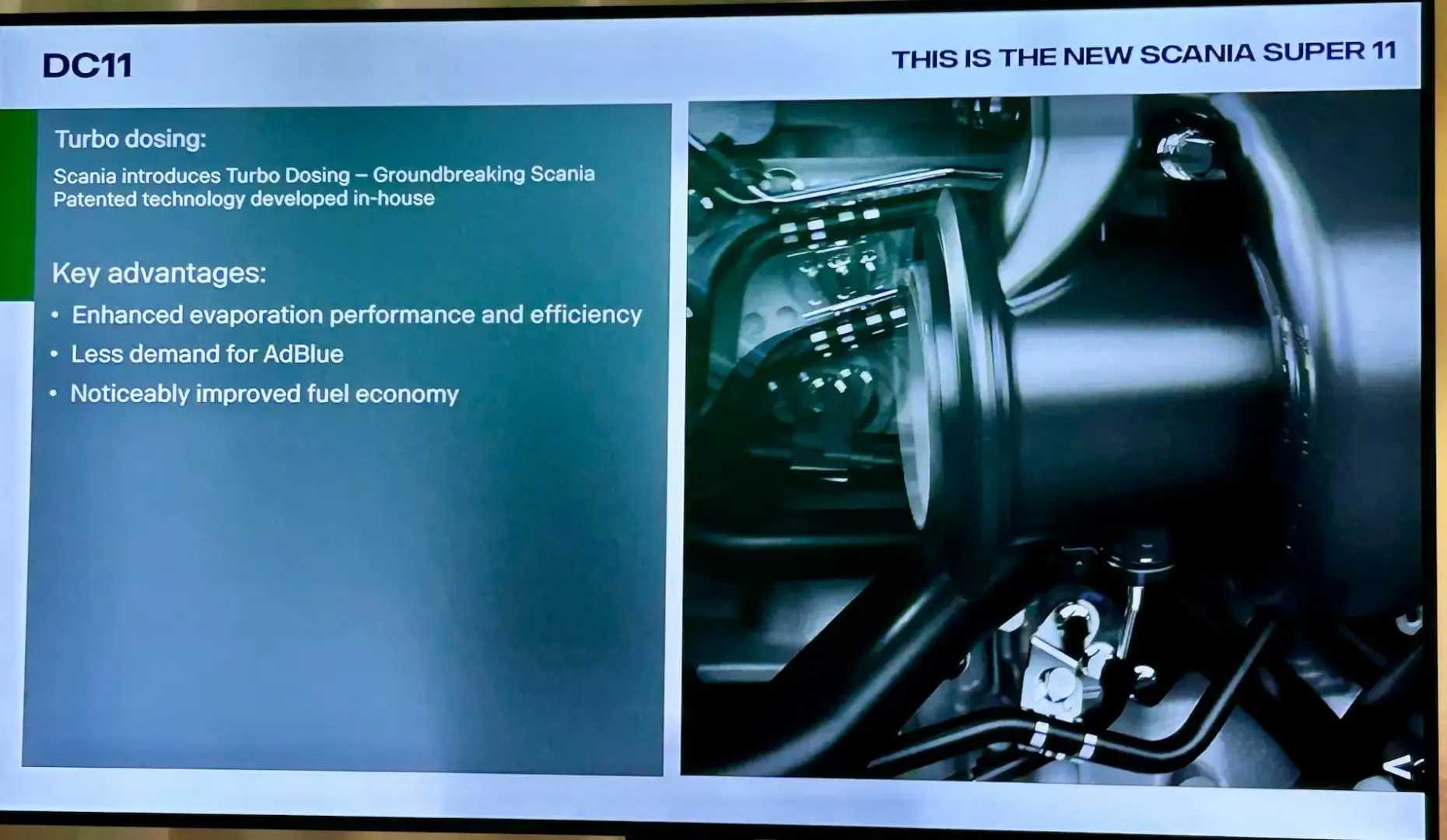
Photo: trans.info
This location features particularly high temperatures and flow speeds, helping the AdBlue evaporate faster and mix more thoroughly with the exhaust. Scania says this improves emissions-control efficiency while reducing the system’s energy demand.
Fuel skewing
Another update is fuel skewing, where the injected fuel quantity varies slightly from cylinder to cylinder. Scania says this reduces unwanted vibrations.
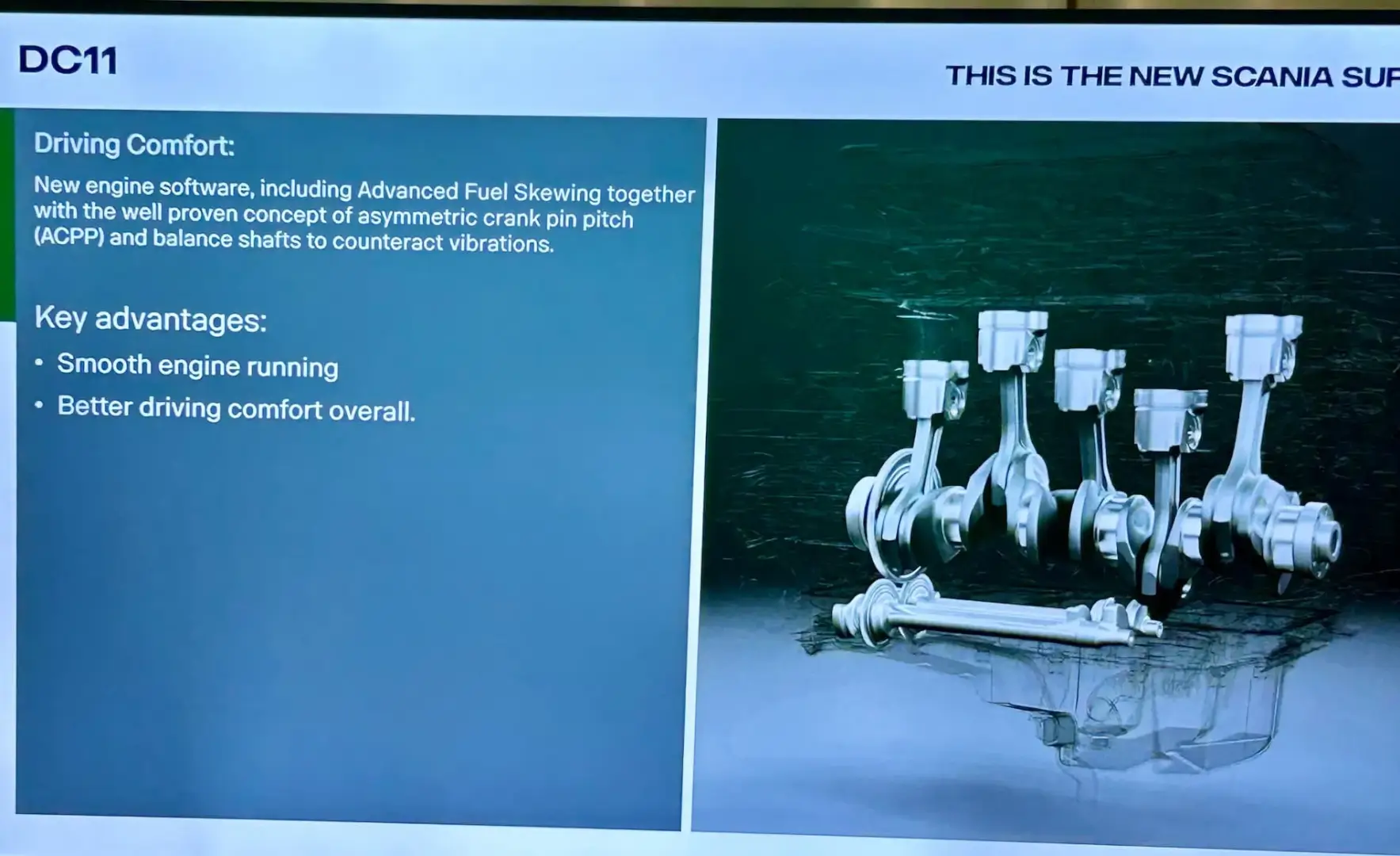
Photo: trans.info
Scania has patented the approach and says it delivers smoother running — particularly noticeable for drivers moving up from the 9-litre engine.
Fuel savings of up to 10%
For transport companies, one metric tends to dominate: fuel consumption.
Against the 9-litre engine rated at 360 horsepower, Scania claims a fuel advantage of 7% to 10%. Compared with the 13-litre engine, the stated saving is 5% to 7%.
With operating costs under pressure, these differences may matter more to fleets than headline power figures.
Scania also noted that any reduction in consumption has an immediate effect. A truck delivered today will remain in service for years, meaning every litre of diesel saved accumulates over the vehicle’s lifetime — in both fuel costs and emissions.
Where Scania expects the Super 11 to fit best
Scania sees the Super 11 as best suited to vehicles up to around 32 to 35 tonnes GVW.
Typical applications include:
- tippers,
- silo combinations,
- tankers,
- refrigerated transport,
- municipal vehicles,
- street sweepers,
- waste collection trucks,
- concrete mixers,
- recovery vehicles,
- vacuum and jetting units.
Scania also highlighted availability with the L cab, which would allow higher-output low-entry trucks for municipal work and waste management using the Super 11.
Designed with Euro 7 in mind
Scania said the platform was developed to meet future Euro 7 requirements. Future noise regulations were also considered during development.
For fleet operators, the argument is planning certainty: trucks ordered today should remain competitive under the next regulatory framework.
Why the Super 11 is more than an incremental diesel update
The Super 11 launch underlines a broader reality: the road freight transition is unlikely to be driven by a single technology.
While electric trucks are gaining ground — especially in distribution — many operators still need ways to run diesel equipment more efficiently and economically.
That is the space Scania is targeting. The Super 11 is positioned as a bridge to wider electrification: less weight, lower fuel consumption and a platform designed around the next wave of regulation.
For many transport companies, those near-term gains are more pressing than predicting when diesel will disappear from the market.