Wednesday morning, 7 January 2026, saw an escalation of the winter crisis on French roads. France’s national meteorological service, Météo-France, issued a “neige-verglas” alert (French for “snow and ice”), which will remain in place until midnight today, while central and local authorities have reached for the most restrictive measures to reduce the risk of accidents and road congestion.
Orange alert and administrative measures
A total of 38 departments, mainly in the north and west of the country, including the Paris region, have been placed under an orange warning level. The alert remains in force until midnight, with a downgrade to yellow expected from Thursday. Snowfall was forecast from Hauts-de-France through Normandy to Île-de-France, along with freezing rain in Pays de la Loire and Poitou-Charentes.
The scale of the phenomenon prompted the activation of an interministerial crisis unit chaired by the Minister of the Interior, with the participation of the Minister of Transport and the Minister of Health. The aim was to coordinate the actions of road, rail and air services.
Truck traffic ban across multiple departments
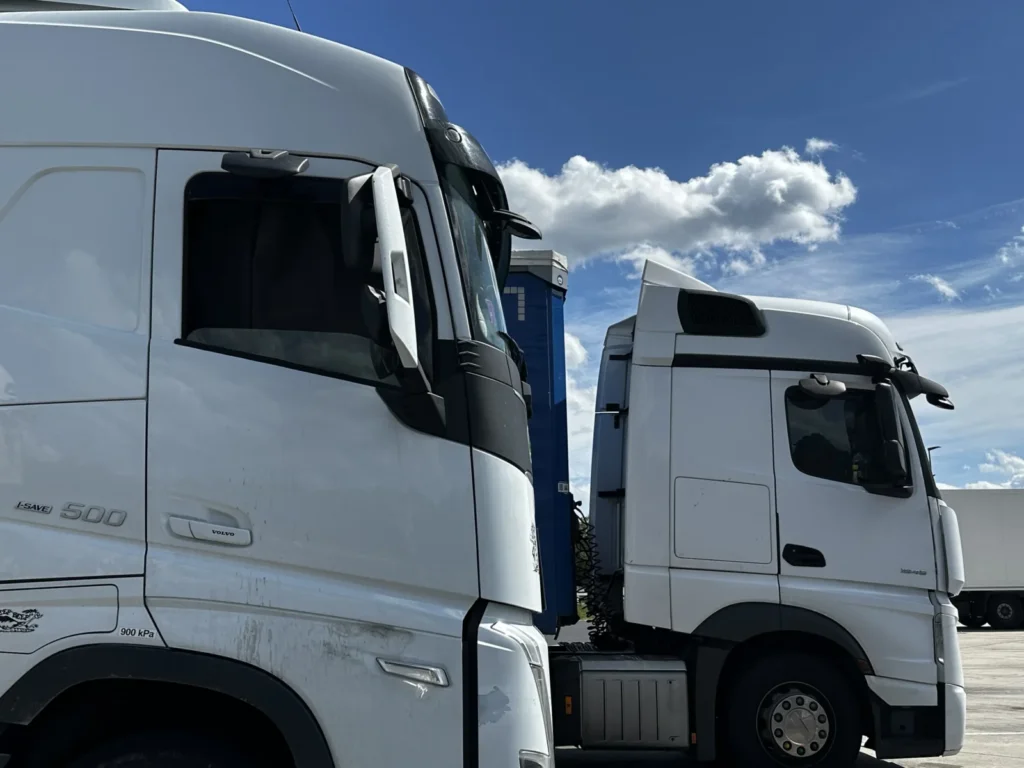
The most important decision from the transport industry’s perspective is the suspension of heavy goods vehicle traffic in 38 departments covered by the alert. The Ministry of Transport confirmed that trucks are not allowed to travel on public roads in these regions, mainly in the north and west of the country and in Île-de-France. The restrictions apply at least until midnight, and whether they remain in place will depend on further developments in the weather situation.
Pour mercredi 07 janvier 2026 :
🟠 38 départements en Vigilance orangeRestez prudents et informés :https://t.co/JGz4rTUvHP pic.twitter.com/vaOut3mch6
— VigiMétéoFrance (@VigiMeteoFrance) January 7, 2026
The bans cover the following departments: Aisne, Allier, Ardennes, Aube, Charente, Charente-Maritime, Cher, Corrèze, Creuse, Eure, Eure-et-Loir, Indre, Indre-et-Loire, Loir-et-Cher, Loiret, Maine-et-Loire, Marne, Nièvre, Nord, Oise, Orne, Pas-de-Calais, Sarthe, Paris, Seine-Maritime, Seine-et-Marne, Yvelines, Deux-Sèvres, Somme, Vendée, Vienne, Haute-Vienne, Yonne, Essonne, Hauts-de-Seine, Seine-Saint-Denis, Val-de-Marne and Val-d’Oise.
In addition, in western France and the Paris region, a ban has been introduced on vehicles with a gross vehicle weight over 7.5 tonnes across the entire national road network, including motorways. For immobilised vehicle combinations, special stopping zones and buffer parking areas have been prepared.
Meanwhile, in the Paris region, level 3 of the “snow and black ice” plan was activated, in force today from 05:30 to 20:00. A speed limit of 70 km/h for all vehicles was introduced, as well as a ban on overtaking manoeuvres by vehicles over 3.5 tonnes on the main arteries.
Activation du niveau 3 du Plan neige et verglas en Île-de-France #PNVIF. Un nouvel épisode de neige est annoncé demain, mercredi 7 janvier.
❌ Mise en place de mesures restrictives de circulation demain de 05h30 à 20h00 :
➡️ Pour l’ensemble des véhicules : limitation de la… pic.twitter.com/UPNbZmjEcS
— Préfecture de Police (@prefpolice) January 6, 2026
French police remind that breaching the ban is punishable by a fixed fine of €135 (a 4th-class offence). However, the amount may be reduced to EUR 90.
Traffic jams and route closures
The effects of the weather chaos are visible on roads across the country. At 09:30, more than 1,600 kilometres of traffic jams were recorded, and the situation was still unstable.
The situation was particularly difficult on the A1, A16 and A26 motorways in the north of the country, particularly on the A21 in Pas-de-Calais, where queues exceeded 100 kilometres. In the south-east, the A8 motorway was closed in the direction of Aix-en-Provence and towards Italy, following a series of accidents caused by snowfall.
Impact on logistics and supply chains
For transport companies, Wednesday’s restrictions mean another day of serious disruption to order fulfilment. The truck traffic ban, closures of key transport corridors and massive congestion translate directly into delivery delays and higher operating costs.
The situation is further complicated by power supply interruptions, affecting, among others, Charente-Maritime, Poitou-Charentes, Loire-Atlantique, Vendée and parts of western France, which may impact the operation of logistics centres and warehouses.
Caution and preparedness are key
French services are calling for travel to be reduced to an absolute minimum. The Directorate General for Civil Security stresses that in winter conditions the individual responsibility of road users is crucial, and forecasts—due to the nature of the phenomena—can change rapidly.
For hauliers, this means the need for ongoing monitoring of administrative and weather announcements, planning alternative routes and preparing for downtime. Wednesday’s crisis once again shows how quickly weather conditions can bring one of Europe’s most important transport markets to a standstill.