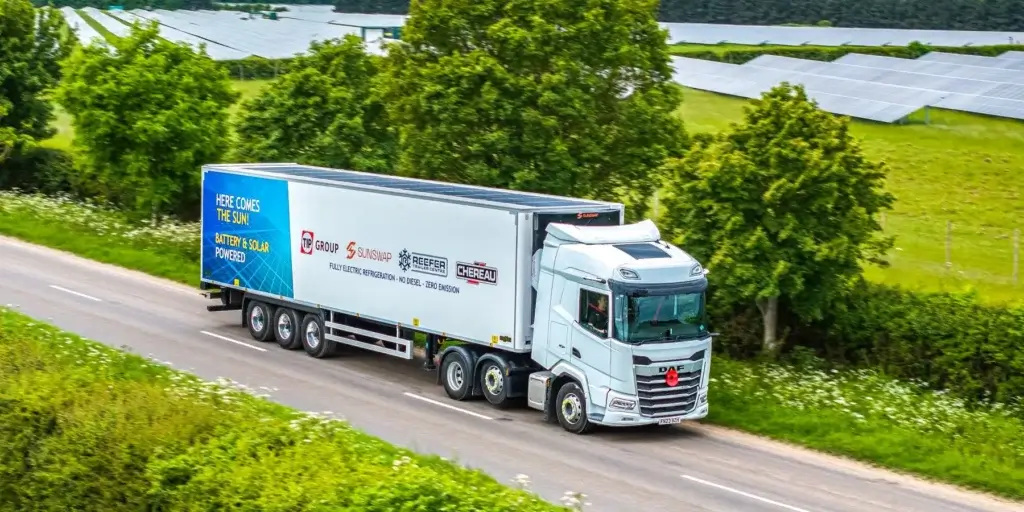
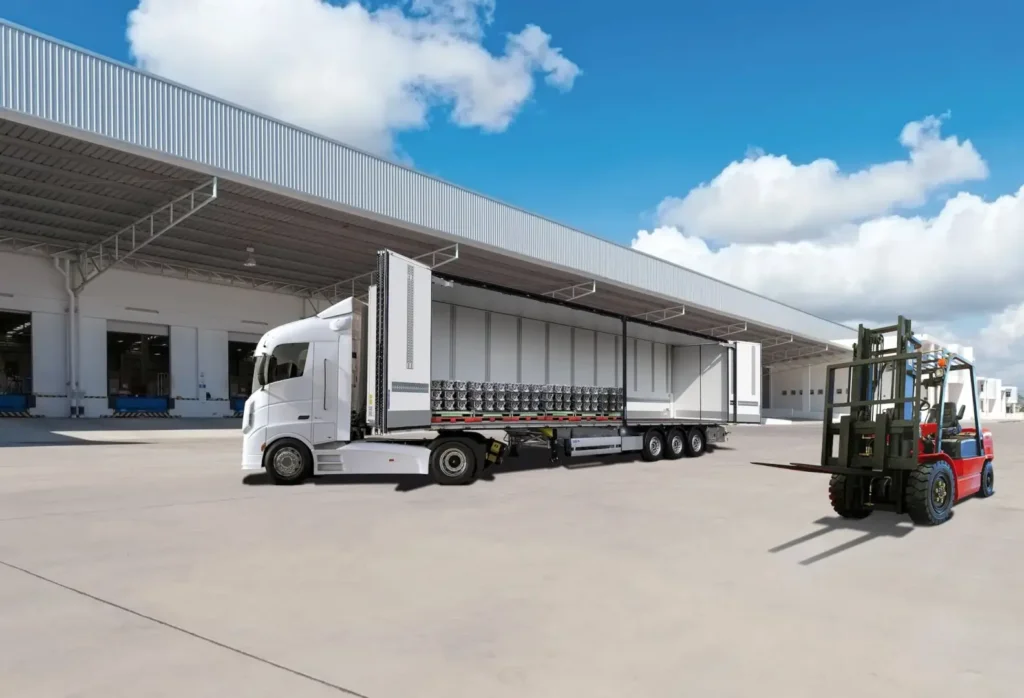
The deployment marks the first operational use in France of Sunswap’s battery- and solar-powered Endurance system, following the manufacturer’s partnership with CHEREAU announced at Solutrans 2025 in Lyon.
Transport refrigeration remains one of the most diesel-dependent parts of the cold chain. While electric tractor units are gradually entering fleets, most refrigerated trailers across Europe still rely on small diesel engines to power cooling systems — adding emissions, fuel costs and noise, particularly in urban deliveries.
From diesel holdout to battery power: refrigeration’s slow electrification begins
Sunswap’s Endurance unit is designed as a fully electric transport refrigeration system rather than a retrofit of an existing diesel platform. The system combines a modular battery pack with rooftop solar panels to power the refrigeration cycle without a combustion engine.
According to the manufacturer, the system is intended for frozen, chilled and ambient operations and can be configured to match different duty cycles. Unlike traditional TRUs, which rely on a small auxiliary diesel engine, Endurance operates independently of the tractor unit’s drivetrain.
The French deployment signals that electric TRUs are beginning to move from controlled trials into day-to-day supermarket distribution — a segment where reliability requirements are high and margins are tight.
21 hours at –20°C: what the early operational data actually shows
Prévoté reports that trials confirmed up to 21 hours of operating range in frozen conditions at –20°C. This duration is central to assessing viability in real-world distribution cycles, where missed cooling performance can compromise load integrity.
According to the operator, higher summer temperatures may slightly reduce operating range, although the trailer’s rooftop solar panels are expected to offset part of that variation.
Sunswap’s published materials indicate that, under certain conditions, the system can support up to 24 hours of frozen operation on a single charge. However, detailed technical data — including battery capacity, degradation assumptions and charging strategy — has not been publicly disclosed.
Modular batteries, rooftop solar and weight trade-offs
The Endurance system uses modular battery packs, allowing operators to scale energy capacity depending on route length and refrigeration intensity. In theory, this enables fleets to optimise between range and payload impact.
Weight remains a critical consideration in refrigerated transport. Sunswap states that on some duty cycles, lower-capacity battery configurations can result in comparable or reduced system weight relative to diesel TRUs. On higher-capacity setups, total mass is described as broadly similar to conventional units. Exact figures depend on configuration.
The rooftop solar installation is integrated into the system architecture rather than added as an auxiliary feature. Solar contribution is intended to extend operating time and reduce reliance on grid charging, particularly during daylight operations.
Beyond cooling: data visibility and remote fleet control
The Endurance unit is connected to a cloud-based software platform that provides real-time monitoring of temperature performance and energy use. Fleet managers can access operational data across multiple trailers, with the aim of improving utilisation, maintenance planning and route optimisation.
Digital visibility is increasingly relevant for operators working under retailer sustainability reporting requirements, where energy consumption and emissions data may become part of contractual reporting frameworks.
The 81% cost claim and the unanswered TCO question
Sunswap states that operating costs can be up to 81% lower than those of diesel refrigeration units. The comparison basis, including fuel price assumptions, maintenance intervals, charging costs and capital expenditure, has not been detailed publicly.
For fleet operators, the total cost of ownership will determine whether electric TRUs can move beyond early adoption. Diesel refrigeration technology is well understood, with predictable servicing costs and established resale markets. Electric alternatives must demonstrate durability, battery longevity and competitive lifecycle economics to secure broader uptake.
No public information has been provided regarding capital cost, warranty structure, battery replacement costs or residual value assumptions.