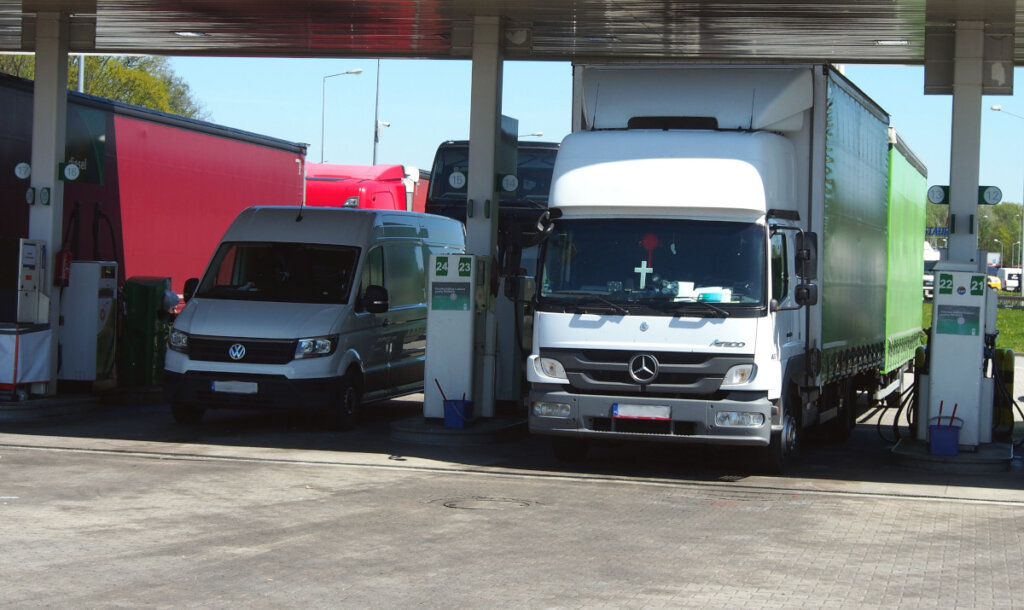
The updated requirements are expected to affect thousands of businesses operating light commercial vehicles on international routes. Whether a tachograph is required will not always depend on vehicle mass alone: the nature of the operation and the driver’s role within the business can be equally decisive.
In recent weeks, companies using vans for cross-border transport have been seeking clarification. Practical interpretations have been published by, among others, the European Commission and the Chamber of Industry and Commerce for Swabia (IHK Schwaben), which has set out how the rules may apply to operators of light commercial vehicles.
The new rules start at 2.5 tonnes
From 1 July 2026, the tachograph obligation will be extended to vehicles with a PMM of over 2.5 tonnes and up to 3.5 tonnes when they are used for international commercial road transport of goods or for cabotage.
In practice, this means EU rules on driving time, breaks and rest periods will apply to a much larger share of van operators involved in international goods transport.
IHK Schwaben stresses that enforcement is based on the permissible maximum mass shown in the vehicle documents, not the vehicle’s actual weight at the roadside. For combinations, the relevant figure is the combined permissible maximum mass of the vehicle and trailer.
In some cases, the new framework may also cover certain car-and-trailer combinations.
Exemptions mean some international operations may still be out of scope
Despite the broader scope, EU law includes exemptions under which certain operations can be carried out without a tachograph.
As IHK Schwaben notes, two exclusions are particularly relevant for businesses operating vans internationally: Article 3(aa) and Article 3(ha) of Regulation (EC) No 561/2006.
The first is the “crafts exemption” in Article 3(aa). It excludes from the driving and rest-time rules the transport of materials, equipment or machinery that the driver needs for their work, as well as the delivery of goods produced as part of a craft activity.
To rely on this exclusion, all conditions must be met simultaneously. The permissible maximum mass of the vehicle or combination must not exceed 7.5 tonnes; the transport must take place within a 100-kilometre radius of the company’s base; driving cannot be the driver’s main occupation; and the transport must be ancillary to the company’s core business.
A second key exemption, in Article 3(ha), concerns vehicles with a PMM of over 2.5 tonnes and up to 3.5 tonnes used for a company’s own-account transport.
In this case, the rules on driving time, rest periods and tachographs do not apply provided the transport is not carried out commercially for third parties, it is performed as part of the company’s own activity, and driving is not the driver’s main job.
Crucially, Article 3(ha) does not include the 100-kilometre radius limit that applies under the crafts exemption. This means own-account transport can also take place on longer routes, including international ones, as long as all other conditions in the regulation are met.
Experts caution, however, that “own account” status does not automatically secure an exemption. The nature of the work remains decisive. If the vehicle is driven by an employee whose primary role is that of a professional driver, the use of the exemption may be challenged during an inspection.
Installing a tachograph is only part of the job
Where a vehicle falls within scope, operators are responsible not only for fitting a tachograph, but also for complying with EU requirements on driving time and rest.
A driver may drive for 9 hours per day, with the limit extendable to 10 hours twice per week. Total driving time must not exceed 56 hours in a week and 90 hours across two consecutive weeks.
After 4 hours and 30 minutes of driving, a break of at least 45 minutes is required. This break may be split into two parts: 15 minutes and 30 minutes.
The rules also define minimum daily and weekly rest periods and require drivers to return regularly to their place of residence or the company’s operating base.
Inspections will include tachograph records
Carriers covered by the new requirements will have to record trips in the tachograph. Data stored in the device may be checked during roadside inspections and at the company’s premises.
Incorrect recording of driver activity, or missing required entries, may lead to administrative penalties.
Many operators are still not ready
With only a month left until the rules take effect, many companies have not completed preparations. An IRU survey published in May found that 88% of vehicles covered by the new rules still need a tachograph installed.
Only 27.7% of operators said they would be ready to meet the new requirements before 1 July 2026, while 46.5% said they had not yet completed their preparations.
Respondents most often cited limited availability of workshops able to install the devices, high installation costs, and difficulties adapting some vehicles to the updated technical requirements.
According to IRU, in the final weeks before the deadline operators should focus not only on installation capacity, but also on driver training, procedures for downloading tachograph data, and adapting work organisation to EU rules on driving and rest time.
Companies face a tight implementation timetable
Companies using vehicles between 2.5 and 3.5 tonnes for international operations should review their fleets, confirm whether any activities qualify for statutory exclusions, and prepare drivers for the new obligations linked to recording driving and working time.
In many cases, a careful review of the exemptions in Regulation (EC) No 561/2006 will determine whether a specific vehicle must be equipped with a tachograph from 1 July 2026.