
For months, Germany’s enforcement approach to the latest Mobility Package rules has been widely expected to be strict. Past inspections have shown that checks can be uncompromising, including in situations where equipment was installed but not put into use. With the obligation now in force, inspections of vans have entered a new phase.
Vans included in A7 enforcement operation
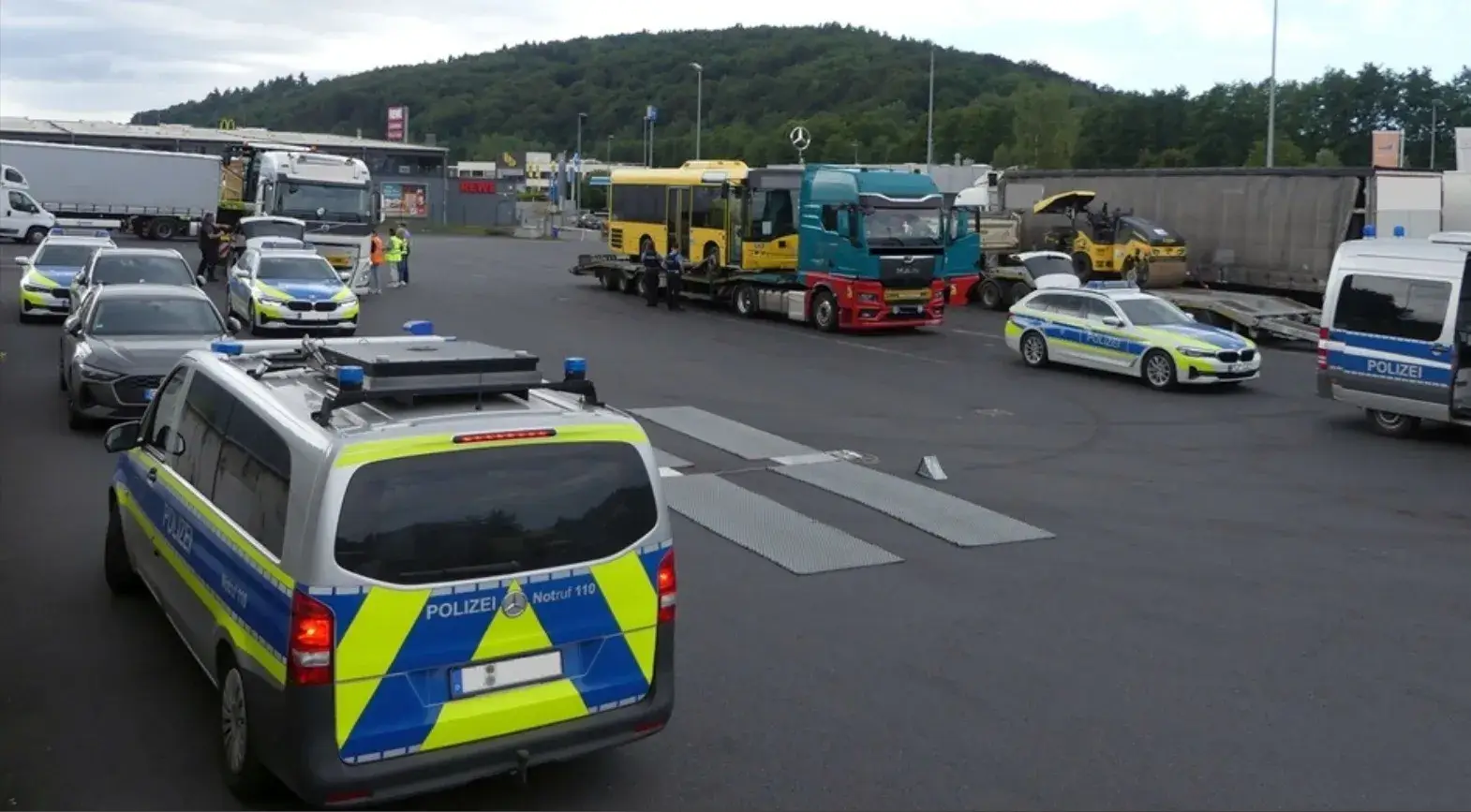
In a joint inspection held last Sunday near Kirchheim on the A7, German police worked alongside the Federal Office for Logistics and Mobility (BALM), regional authorities, the Hessen Mobil road operator and a technical expert.
The operation covered abnormal loads, heavy vehicles and commercial road freight. Inspectors reported, among other issues, serious overloading, major technical defects, dangerous problems with load securing, and infringements of driving and rest-time rules. Out of 26 vehicles checked, 10 were ordered off the road until the violations were corrected.
One case involved a truck carrying used tyres. The load had not been secured properly and shifted to one side while driving, pushing out the curtain side. The vehicle was stopped, and the operator was required to fully unload the trailer.
Light commercial vehicles were another key focus
Inspectors also paid close attention to light commercial vehicles involved in cross-border freight, reflecting the rules in force since 1 July 2026. Under these provisions, vehicles and vehicle combinations with a permissible gross weight above 2.5 tonnes used for international road transport of goods must be fitted with a smart digital tachograph.
During the checks, officers found three vans that had no tachograph installed despite the requirement. Drivers were fined, and all three vehicles were barred from continuing until the non-compliance was resolved.
The checks suggest there is no grace period in practice, with enforcement starting immediately after the rules took effect.
Strict approach was visible even before the rules took effect
For many carriers, this will not come as a surprise. Even ahead of 1 July 2026, German authorities showed they could apply tachograph security updates very rigidly.
One Polish operator learned this first-hand after choosing to install a second-generation smart tachograph early to avoid workshop backlogs. During a roadside check by motorway police and BALM, it emerged that although the device had been fitted, it was not being used. The driver was not using a driver card, because EU rules had not yet made that mandatory.
German enforcement officers took the view that once a tachograph is present in the vehicle, it must be active and used in line with national requirements. The inspection ended with a fine of 250 euros.
A warning for carriers
The A7 operation supports earlier warnings that enforcement would be tight. Less than a week after the rules began to apply, German services were already identifying missing tachographs in vans, issuing penalties and ordering vehicles off the road.
For companies running international road freight, this means non-compliance can lead not only to a fine, but also to a forced standstill and delays in completing transport orders.
For international operators active in Europe, compliance risks are also rising as countries crack down on tachograph fraud with tougher penalties and wider roadside powers.
The case also underlines the growing importance of how tachograph data is treated during roadside checks.