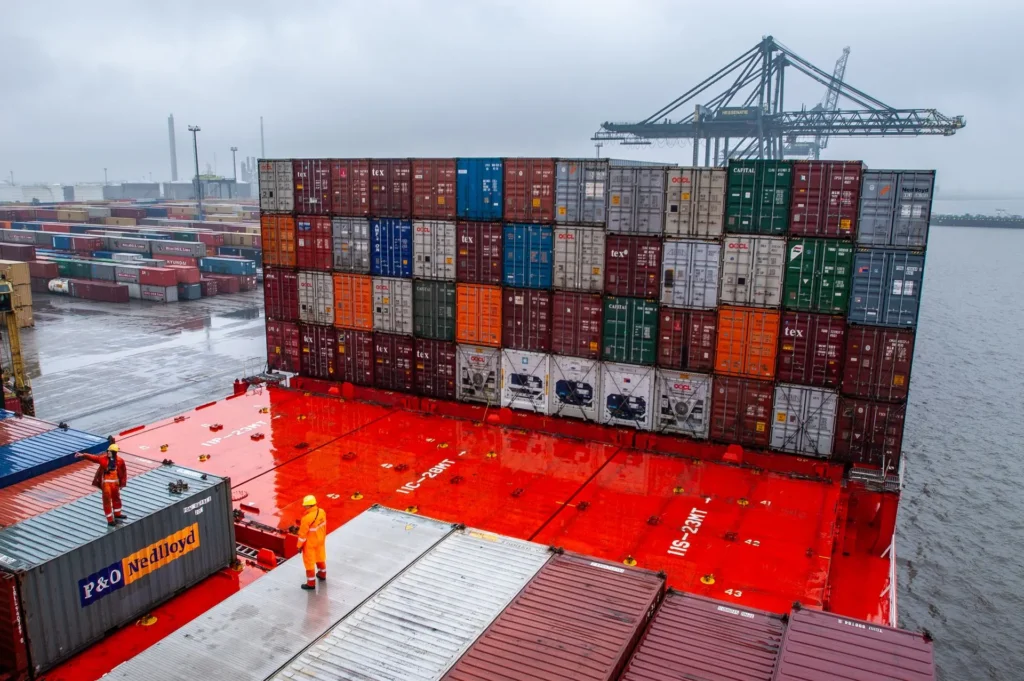
The number of containers lost at sea rose sharply in 2025, with the World Shipping Council reporting 1,478 losses worldwide, up from 576 a year earlier. The figure comes from WSC’s latest Containers Lost at Sea update, published in June 2026, and covers around 280 million containers transported globally — meaning losses still represented just 0.0005% of all container movements. The increase is nonetheless notable after two comparatively low-loss years, and again highlights the role of extreme weather, fire, cargo shift and major vessel incidents in container safety.
WSC says the 2025 total was heavily influenced by a small number of large incidents rather than a broad deterioration across the sector. One major incident alone accounted for 640 containers, or around 43% of all losses during the year. A further 128 containers were reported as recovered, which WSC describes as the highest recovery figure recorded to date.
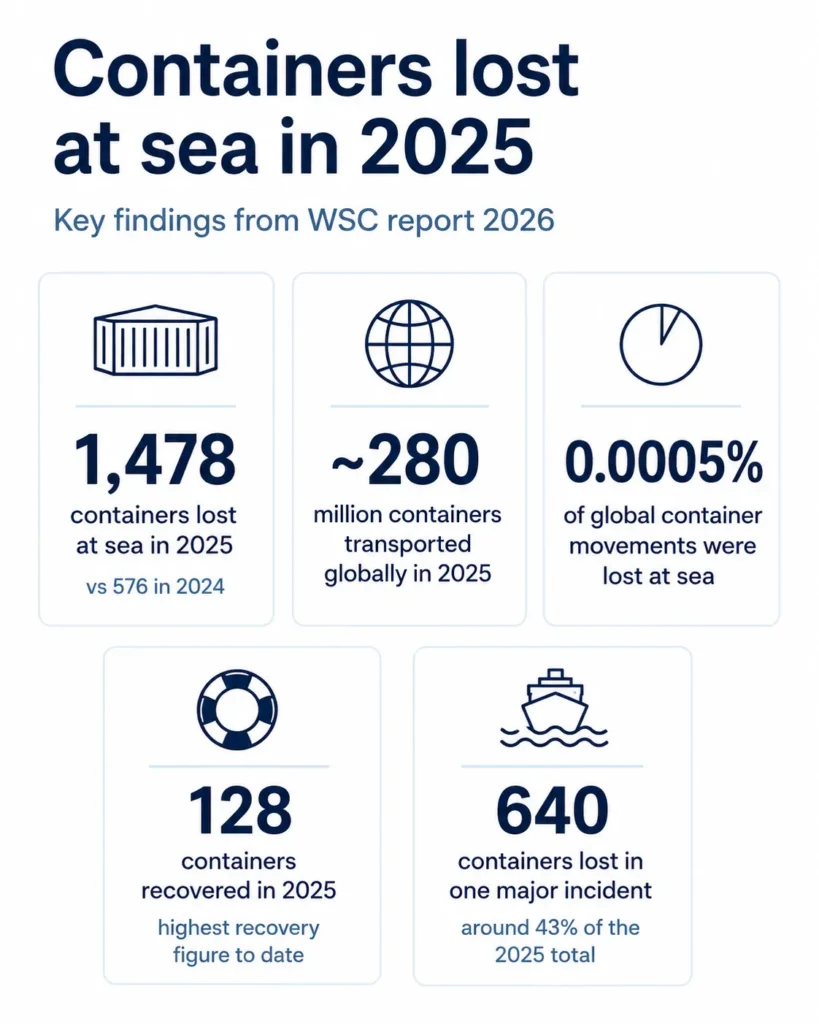
Containers lost at sea in 2025: key WSC figures
Major incidents drove the annual increase
The 2025 figure reverses the sharp decline seen between 2022 and 2024, though WSC stresses that annual totals can fluctuate significantly because of isolated large-scale events. Losses were driven by one major vessel-loss incident, as well as a handful of further incidents involving severe weather, stack collapse or cargo shift. Although the total number of storms globally was not significantly above average, WSC says the year was marked by warmer-than-normal ocean temperatures, periods of more severe and less predictable weather, and difficult regional operating conditions.
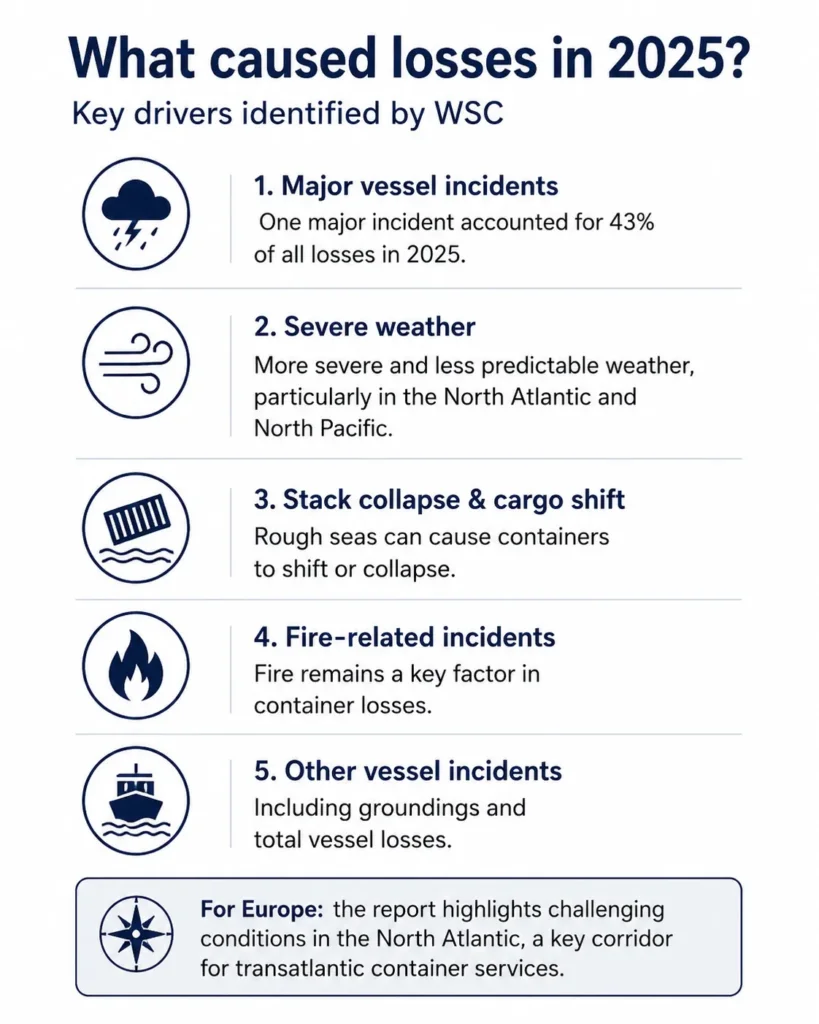
What caused container losses at sea in 2025?
For European shippers, forwarders and ports, the report is particularly relevant because WSC specifically refers to challenging conditions in the North Atlantic, one of the key corridors for transatlantic container services. The report does not provide a Europe-specific breakdown of container losses, nor does it say that losses rose on European routes. However, its reference to more severe and less predictable weather in the North Atlantic underlines the exposure of European supply chains to weather-related disruption and cargo risk at sea.
Not only a maritime issue
While the report is focused on container losses at sea, WSC also makes clear that container safety begins long before a vessel leaves port. The organisation says it is a shared responsibility across the supply chain, involving shippers, packers, freight forwarders, terminals, stevedores, ocean carriers and vessel operators.
The most practical warning concerns cargo packing, securing and declaration: cargo must be properly packed, braced and declared, while accurate weight declarations are essential for safe stowage and lashing planning. Misdeclared or improperly packed cargo can compromise container stability and increase the risk of collapse or loss, particularly in heavy seas. Terminals and stevedores are responsible for handling, positioning and stowing containers according to the vessel’s loading plan, while ocean carriers and vessel operators bear responsibility for stowage and lashing plans, safe voyage execution and weather routing.
Fire risk and dangerous goods remain a concern
WSC also points to fire-related incidents as one of the factors behind container losses, linking this to wider concerns about undeclared or misdeclared dangerous goods, which it says have contributed to ship fires reaching their highest level in more than a decade.
In response, WSC launched a Cargo Safety Program in 2025, using a digital cargo-screening tool powered by National Cargo Bureau technology to review bookings through keyword analysis, trade-pattern recognition and artificial intelligence. Where risks are flagged, carriers can take further action, including targeted physical inspections.
WSC stresses, however, that screening cannot replace the legal responsibility of shippers to declare goods correctly, and that accurate cargo declaration remains the foundation of safety.
New IMO reporting rules now apply
The latest report also comes at a regulatory turning point. From 1 January 2026, new mandatory reporting requirements apply under amendments to the International Convention for the Safety of Life at Sea, requiring the industry to report containers lost at sea or observed drifting, while flag states must report loss figures to the International Maritime Organization. WSC says the new rules should improve data accuracy, support faster response actions and help reduce navigational and environmental risks.
The organisation will continue collecting and publishing data alongside the IMO system to maintain consistency and allow comparison with previous years.
Despite the 2025 increase, the latest figure remains well below earlier peak years. WSC’s historical data shows the highest recorded annual loss was in 2013, when 5,578 containers were lost, while the lowest was 2023, with just 221. The 2025 rebound illustrates how strongly the annual figure can be distorted by single major incidents, yet container losses remain rare relative to the scale of global trade.


![Costs up 11%, rates up 5%: FarEye’s Suryansh Jalan on the hidden “inefficiency tax” in Europe’s last mile [INTERVIEW]](https://cdn-trans.info/uploads/2026/10/264940df8e8870b74281e69aeac-1024x769.webp)