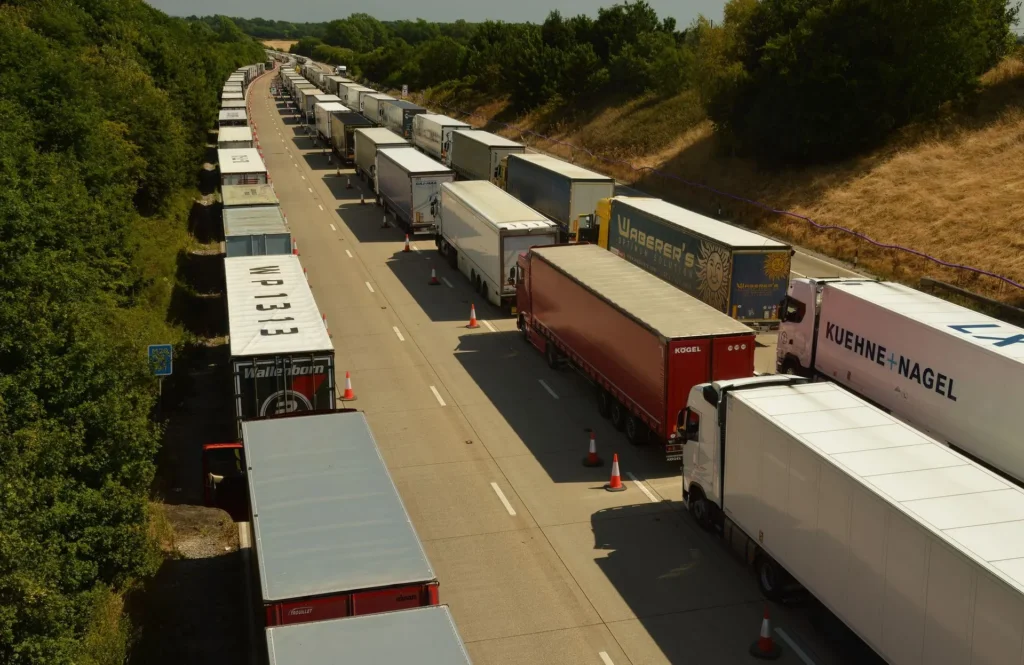
The warning follows concerns raised by the Port of Dover earlier this month. Port chief executive Doug Bannister said tourist traffic undergoing EES processing could spill onto the approaches used by freight, trapping HGVs even though many lorry drivers do not need to register under the system.
Dover has called for EES checks to be suspended during the summer or stood down selectively before queues begin to form. The port said delays reached around 4.5 hours during the May half-term after only a few hours of EES processing, while summer traffic can rise to more than 12,000 tourist vehicles a day.
Border security minister Alex Norris told the House of Commons on Wednesday, 8 July, that, when traffic volumes peak, authorities could face a fundamental choice between keeping vehicles moving and fully applying the new border system.
“The fundamental question will be the prioritisation of flow or of compliance with the scheme,” Norris said during an urgent parliamentary debate on 8 July.
He said the Government was putting daily pressure on France and the European Commission to ensure French border police use the flexibilities available under EES to prioritise traffic flow.
Warning of 12-hour delays for passengers and freight
The debate was opened by Conservative MP Sir Roger Gale, who represents the Kent constituency of Herne Bay and Sandwich.
Gale said that, based on bookings for the approaching holiday season, authorities were predicting delays of up to 12 hours for passengers and, as a consequence, freight traffic.
He urged the Government to seek a waiver before the main summer holiday period begins, rather than waiting for severe congestion to develop. Norris did not confirm the 12-hour estimate but acknowledged that long queues would affect both individuals and businesses. He said ministers were seeking arrangements under which French officers could ease checks when traffic volumes exceeded the system’s capacity.
The Government is not, however, calling for EES to be suspended completely. Norris said a full suspension was not a realistic or deliverable objective. Instead, ministers want checks to be adjusted at particular peak periods, using traffic forecasts to identify problems before queues form.
Similar flexibilities were used on 23 May, when French border police changed their procedures to relieve congestion on the Kent road network during the late May bank holiday.
Freight caught behind passenger traffic
EES primarily affects non-EU travellers entering the Schengen area, rather than introducing a new cargo-control procedure for HGVs.
The risk for road freight is nevertheless considerable because passenger vehicles and lorries rely on the same port approaches and parts of the same road network around Dover and Folkestone. Delays caused by biometric registration can therefore spill over into commercial traffic.
Norris acknowledged that EES would not be the only cause of congestion in Kent, where queues already occur during peak travel periods, but said the system risked becoming a “compounding factor”.
Operation Brock to return for six weeks
The warning comes as Kent prepares to reinstate Operation Brock on the M20 ahead of the summer getaway. The contraflow will be installed between junctions 8 and 9 on the evening of Monday 13 July, with the motorway due to reopen under the system on Tuesday 14 July. The barrier is expected to remain in place until 24 August — around six weeks.
Under the arrangement, coastbound traffic will use a contraflow between Maidstone and Ashford, while dedicated lanes will be available for HGVs to queue. All lorries heading for the Port of Dover or Eurotunnel will be required to join Operation Brock at junction 8.
The Kent and Medway Resilience Forum said the measure was intended to limit disruption to local communities during the summer traffic surge. Permitting will also be used to keep freight on the M20 and A20, while Lydden Hill Race Circuit will be available as a last-resort holding area for passenger vehicles during major disruption.
In Parliament, Norris pointed to Operation Brock and the Dover Traffic Assessment Project as part of Kent’s contingency arrangements. However, the system manages queues rather than eliminating them: HGV drivers may still face long waits if EES processing causes traffic to build around Dover and Folkestone.
No guaranteed priority for perishable loads
MPs also pressed the Government to ensure that perishable goods, including seafood and other short-life produce, receive priority access to the ports. John Cooper, Conservative MP for Dumfries and Galloway, warned that haulage, agricultural and fisheries businesses were heavily dependent on Dover and that the value of seafood cargo could disappear “practically overnight” when shipments were delayed.
SNP MP Graham Leadbitter later asked for a firm commitment that perishable loads would be prioritised.
Norris recognised that time was critical for some products but stopped short of promising a dedicated priority system. He said prioritisation was difficult because vulnerable passengers and many other road users also had legitimate reasons to move through queues quickly.
Infrastructure ready, technology still causing problems
The Government has provided £3.5 million each to Dover, Eurotunnel and St Pancras to support infrastructure changes and the purchase of EES equipment. MPs said Dover itself had invested more than £40 million in preparations, but parts of the infrastructure cannot yet be used fully because the technology required to operate the system is not working as intended.
Norris said physical infrastructure alone could not solve the problem until the technology linked to it became operational and could be properly tested.
The Government said discussions with France, the European Commission and transport operators would continue daily ahead of the summer peak, with the immediate objective of allowing border officers to relax procedures before congestion reaches critical levels.