


Key takeaways:
- Daimler Truck estimates a penalty of around €120 million for each percentage point by which it misses its CO2 target.
- The manufacturer says roughly 35% of new European trucks would need to be zero-emission by 2030.
- Battery-electric trucks represented only around 2% of the relevant market in 2025.
- Mercedes-Benz Trucks recorded EBIT of €698 million in 2025.
- Daimler wants the EU to examine whether charging infrastructure and other market conditions are developing quickly enough to support the targets.
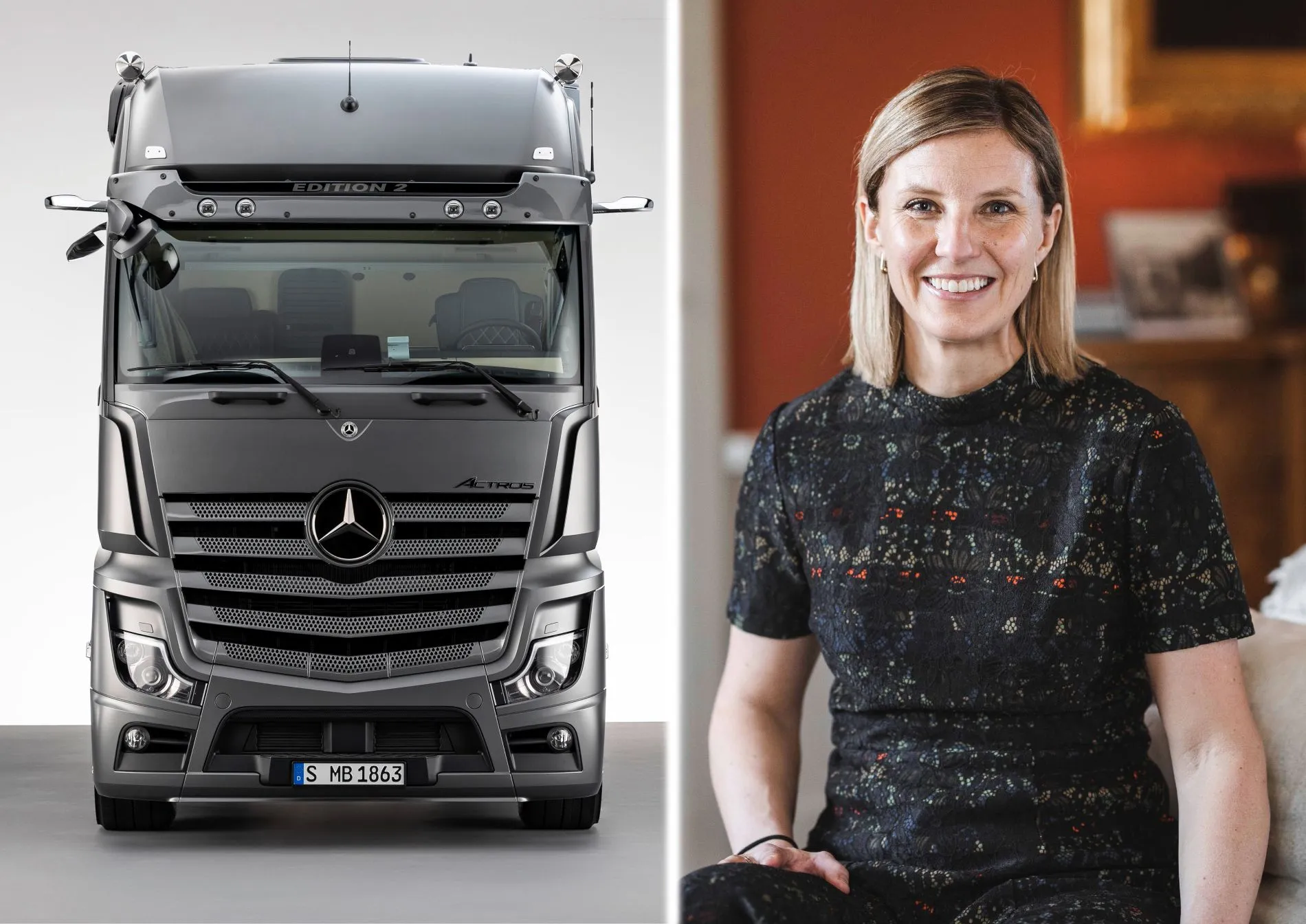
Chief executive Karin Rådström estimates that Daimler Truck could be liable for around €120 million for every percentage point by which it misses its manufacturer target.
“If we miss the targets by ten percentage points, for example, we will practically no longer make any money from the Mercedes-Benz Trucks segment,” Rådström said in an interview with the German news agency dpa.
The calculation is Daimler Truck’s own estimate rather than a fine already imposed. However, it illustrates the financial exposure facing truck manufacturers if sales of battery-electric and hydrogen vehicles fail to rise quickly enough.
Ten-point shortfall could exceed 2025 profit
A ten-percentage-point shortfall would imply penalties of approximately €1.2 billion under Daimler Truck’s calculation. For comparison, Mercedes-Benz Trucks recorded EBIT of €698 million in 2025, down 24% from €922 million in 2024. Its adjusted EBIT, which excludes certain exceptional items, was €1.23 billion. Revenue fell 4% to €19.74 billion. That means the hypothetical €1.2 billion penalty would be substantially greater than the division’s reported EBIT and close to its adjusted operating result.
Rådström said such penalties could have existential consequences for Europe’s commercial-vehicle industry and warned that the current regulatory framework risked damaging its competitiveness.
Zero-emission sales would need to rise sharply
EU legislation requires manufacturers to reduce average CO2 emissions from most new heavy-duty vehicles by 45% from 2030, compared with 2019 levels. The reduction requirement increases to 65% from 2035 and 90% from 2040. The exact compliance requirement can vary according to the vehicle categories and sales mix involved. Rådström referred to an effective reduction of around 43% for the heavy trucks covered by her calculation.
Daimler Truck estimates that meeting this would require approximately 35% of new European truck registrations in 2030 to be battery-electric or hydrogen-powered.
The starting point is much lower. According to the figures cited by Rådström, electric vehicles accounted for only around 2% of European heavy-truck registrations in 2025. The required 35% zero-emission share is not itself a statutory sales quota; it is Daimler Truck’s estimate of the vehicle mix needed to bring average emissions down sufficiently.
Daimler points to hauliers’ operating economics
Rådström argued that manufacturers cannot create the necessary sales volumes alone because the purchasing decision ultimately rests with transport operators. She said hauliers commonly operated on narrow margins and that diesel remained the economically rational choice for many customers. The barriers identified in the interview included higher vehicle costs, insufficient charging infrastructure and uncertainty over whether electric trucks could be used economically across operators’ transport assignments.
This places manufacturers in a difficult position: they face penalties based on the average emissions of the vehicles they sell, while demand is influenced by electricity prices, charging access, taxation, toll policy and the economics of individual routes.
Daimler Truck has also begun developing its own semi-public TruckCharge network, which is expected to include more than 3,000 fast-charging points across Europe by 2030. The initiative allows operators to make depot chargers available to third parties, but it represents only one part of the infrastructure required for large-scale electric-truck adoption.
Call for a ‘reality check’
Rådström is not calling for the decarbonisation of road freight to be abandoned. Daimler Truck already sells battery-electric models including the Mercedes-Benz eActros 600 and continues to develop hydrogen fuel-cell trucks. Instead, she wants the EU to review whether the conditions needed to meet the regulation are developing at the same pace as the obligations placed on manufacturers.
Her argument is that CO2 compliance should be assessed alongside the availability of truck charging, grid connections and economic incentives capable of making zero-emission vehicles commercially attractive to operators.
The intervention adds to pressure from Europe’s commercial-vehicle industry for an earlier review of the rules. However, the existing targets were deliberately designed to force manufacturers to reduce the average emissions of new vehicles and accelerate the transition away from diesel.


