

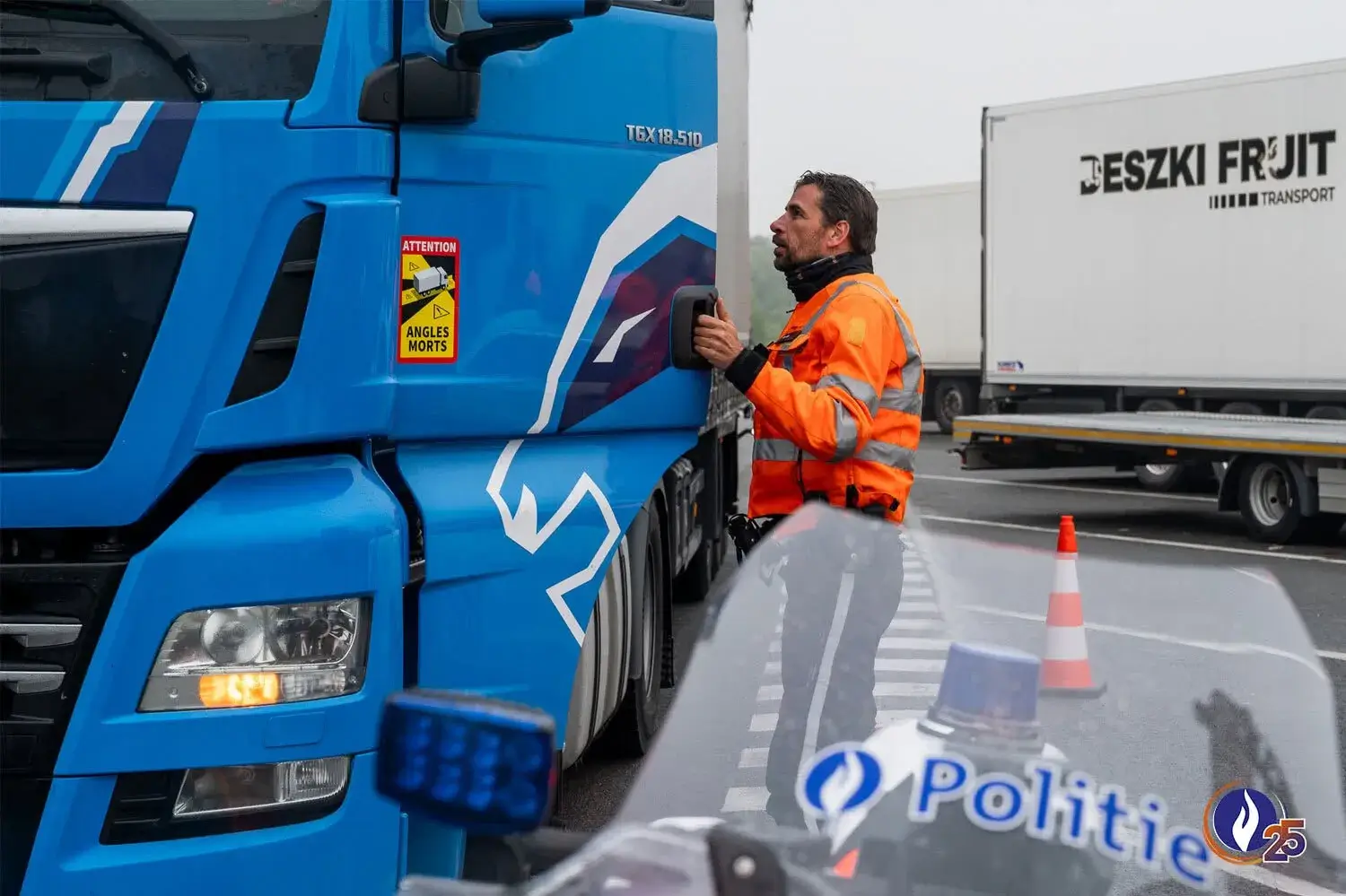

Haulage operators and international drivers should expect more frequent stops, both on domestic roads and while transiting other European Union countries. The checks are coordinated and carried out in parallel across multiple states, ROADPOL said. The operation follows similar joint actions conducted in previous years.
ROADPOL ramps up checks across Europe
The ROADPOL “Alcohol & Drugs” campaign aims to reduce crashes caused by drivers under the influence of alcohol or intoxicating substances. Alongside enforcement, police forces are also expected to run preventive and educational activities.
The operation is expected to peak on 19 June 2026, when additional patrols will be deployed and checks will run almost continuously as part of a 24-hour enforcement push. For professional drivers, this increases the likelihood of routine stops and mandatory breath testing, even where no driving irregularities are observed.
Different alcohol limits across Europe: where the rules are toughest
Permitted blood alcohol concentration (BAC) limits for car drivers vary across Europe:
- Zero tolerance (0.0): a complete ban on driving after drinking applies, among others, in Czechia, Slovakia, Romania and Hungary.
- Strict limits (0.2): very low thresholds are used, among others, by Norway, Sweden, Estonia and Poland.
- Common European standard (0.5): the most widespread limit for car drivers, in force, among others, in Germany, France, Italy, Spain and Belgium.
Lower thresholds for professional drivers
For road haulage, it is important that many countries set tighter limits for truck drivers than for private motorists. In some states, professional drivers must be fully, or almost fully, sober, including:
- Germany – 0.0 for professional drivers (while the limit for car drivers is 0.5)
- Italy – 0.0 for professional drivers (0.5 for car drivers)
- Belgium – 0.2 for professional drivers (0.5 for others)
Poland: rules and tough penalties
In Poland, the legal limit for all drivers is a BAC of 0.2. Exceeding that threshold can trigger serious legal consequences, depending on the reading:
- From 0.2 to 0.5 (after drinking – an offence): a fine from 2,500 to 30,000 zloty, 15 penalty points, and a driving ban from six months to three years.
- Above 0.5 (intoxication – a crime): penalties include up to three years in prison, a driving ban of at least three years, and a mandatory financial payment (minimum 5,000 zloty).
- Above 1.5: the law provides for mandatory forfeiture (confiscation) of the vehicle or its equivalent value. Confiscation also applies to drivers who cause an accident while intoxicated or flee the scene. Penalty points for the most serious offences cannot be reduced through training courses.
Drug testing on EU roads: saliva tests in the spotlight
The second pillar of the ROADPOL operation is drug detection using mobile saliva tests. These rapid screening devices can identify, within five to ten minutes, substances such as THC (cannabis), amphetamines, cocaine and opiates.
For international drivers, a key issue is detection windows. Unlike alcohol, some substances — particularly THC and amphetamines — can remain detectable in saliva for several days and, in some cases, for more than a week after use.
In many European jurisdictions, enforcement does not rely on fixed threshold values for intoxicants in the blood. If a roadside screening test is positive, the driver may be detained and taken for a blood test. The final assessment in court — including whether the driver posed a direct road-safety risk — is issued by a licensed toxicology expert based on laboratory analysis.


