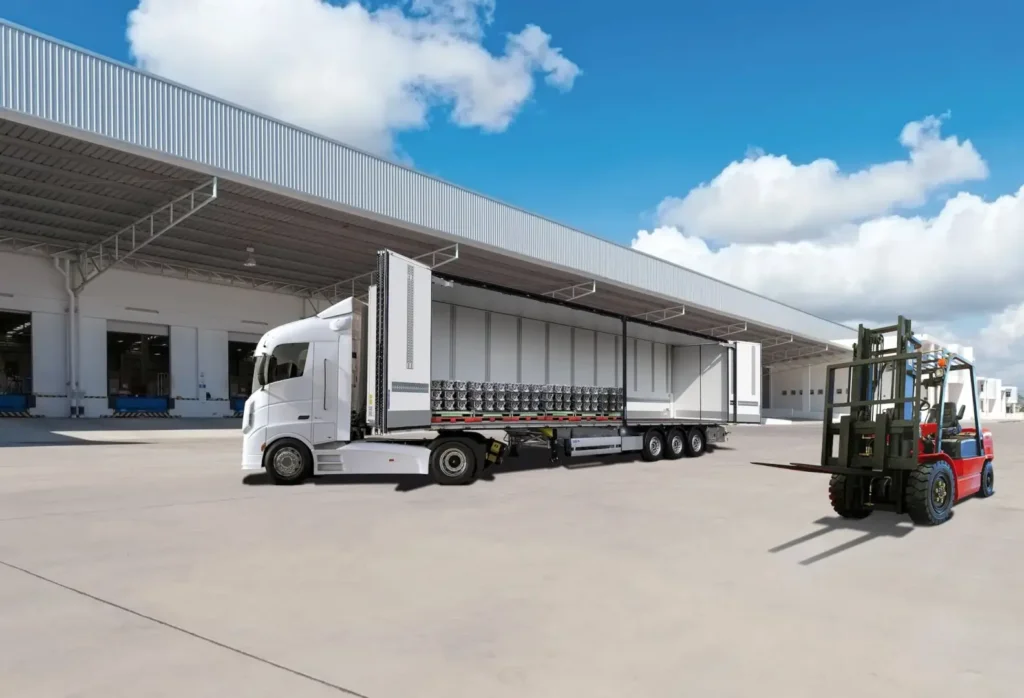
In the CargoTrailSense_AI project, a team from Dortmund University of Applied Sciences and Arts examined how axle loads, load distribution and road surface stress can be recorded directly on the trailer itself. The aim was to develop a system suitable for everyday use, capable of delivering reliable data without requiring vehicles to stop for additional checks.
From trailer to a “mobile measuring lab”
As part of the project, semi-trailers were equipped with strain gauges, acceleration sensors and intelligent analysis software. Air suspension bellows with integrated sensor technology were also used, developed in cooperation with industry partners.
The sensors continuously record load levels, axle loads and vibrations. Data is transmitted via a telematics connection to a cloud platform, where it is analysed. Crucially, the technology was not tested in laboratory conditions but in real operations — on different routes and under varying loading scenarios — to create a robust and realistic data set.
Accurate load data without weighbridge delays
According to Dortmund University of Applied Sciences and Arts, the system achieved deviations of less than one percent compared with stationary weighbridges when determining vehicle and axle loads, at least once calibrated. For haulage companies, this has clear practical implications:
- no waiting times at weighbridges,
- continuous monitoring of load conditions while driving,
- reduced risk of overloading and fines.
The sensor technology also opens up possibilities for predictive maintenance. Changes in measurement data can indicate tyre wear or brake issues at an early stage, helping operators prevent breakdowns and unplanned downtime.
Project leader Prof Dr Yves Rosefort summarised the outcome as follows:
“With this project, we have shown that by combining different sensors and advanced technology on the trailer, it is possible to create a highly complex yet extremely powerful system.”
Trucks as “road scanners” for authorities
Beyond logistics applications, the project also focuses on infrastructure monitoring. Using AI-supported analysis, the system can identify road damage such as potholes while driving. According to the university, the detection rate is around 80 percent.
Such data could be of interest to road authorities, as it not only makes damage visible but also allows conclusions to be drawn about the actual loads imposed by heavy goods traffic. Dortmund University of Applied Sciences and Arts reports that Germany’s Federal Highway Research Institute (BASt) has already expressed interest in the research data.
Marius Jones, a research associate involved in the project, sees this as an inevitable development:
“Sooner or later, this kind of sensor technology will have to become standard equipment in trucks.”
Benefits for hauliers — and the cost question
For the transport industry, the potential benefits are clear: reduced downtime, lower operational risk, improved planning reliability and new options for fleet management. Reliable data could also help make discussions about axle loads and infrastructure impacts more objective.
However, obstacles remain before the technology can be rolled out on a large scale. For manufacturers and fleet operators, costs are a decisive factor. In a highly competitive market, even a few hundred euros of additional expense per trailer can be critical.
This is why incentive models are being discussed, such as toll discounts for operators that make anonymised road-condition data available to public authorities. Inefficient loading, overloading and unplanned downtime already cause significant economic damage across the sector.
Project partners and funding
The project was coordinated by Dortmund University of Applied Sciences and Arts. Partners included BPW Bergische Achsen, ContiTech (Continental), OKIT, F&T LaSiSe and the Port of Lünen, alongside other technology and consulting companies. Trials were carried out together with haulage operators in real driving conditions.
CargoTrailSense_AI had a total project volume of around €2.8 million and received €2.19 million in funding under the mFUND innovation initiative of the German Federal Ministry for Digital and Transport.
EU framework: permitted, but not mandatory
At EU level, Directive 96/53/EC, as amended by Directive (EU) 2015/719, remains in force. It sets limits on vehicle weights and axle loads and requires Member States to improve enforcement against overloading. However, it does not mandate the use of a specific technology.
Both stationary weighing systems and on-board solutions installed in vehicles or trailers are permitted, provided they are reliable and interoperable. In practice, Member States have so far relied mainly on spot checks and weigh-in-motion systems embedded in the road network.
As of 2026, there is still no obligation to equip trucks or trailers with sensor technology — but the legal framework explicitly allows it. This is precisely where the trailer-based sensor system tested in the CargoTrailSense_AI project could find its place.