New analysis from charging operator Milence suggests some countries are already offering a workable cost case for battery-electric freight, while others are still being held back by weaker incentives, uneven charging rollout and less favourable operating conditions.
Milence says electric heavy-duty truck adoption is moving beyond the pilot phase in a small group of leading markets, including Switzerland, Denmark and the Netherlands, while many other European countries remain at a much earlier stage of electrification. According to the company, the gap is being shaped less by technology than by national policy frameworks, electricity pricing, toll systems and the availability of truck-suitable public charging.
Read more: Electrification, the stiff collar of road transport: uncomfortable, costly, but no longer optional
The company’s assessment, which looks across 14 European countries, argues that markets move faster when several conditions are in place at the same time:
- competitive power prices,
- CO₂-differentiated road tolling,
- long-term financial support
- and reliable public charging infrastructure for heavy-duty vehicles.
Where those pieces are missing, uptake remains slower and less predictable.
Milence’s updated total cost of ownership modelling also points to widening differences between national markets. In the Netherlands, it says electric trucks already show a cost advantage in several use cases from 2026 onwards. In Germany, the extension of full toll exemptions for zero-emission trucks until 2031 is described as a major economic driver. In Sweden, lower electricity prices support electrification, but the absence of similar toll incentives means long-haul cost parity is expected later.
The white paper gives a clearer picture of how wide those differences are. In Germany, Milence says the full LKW-Maut exemption creates an advantage of €0.32 per kilometre on tolled roads, and around €0.24 per kilometre on average in the long-haul use case presented, where 75% of kilometres are assumed to be driven on toll roads. In the Netherlands, the paper says the business case becomes structurally competitive from 2027 even without subsidies. In Sweden, by contrast, the TCO gap is still put at about €0.11 per kilometre today, narrowing to €0.04 in 2027, with a positive TCO expected in 2028.
Another factor in the calculations is fuel market volatility. Milence argues that recent oil and gas price swings have pushed truck operating costs up by 9 to 11 euro cents per kilometre, strengthening the appeal of electricity as a more stable energy input, particularly where it is linked to domestic renewable generation. At the same time, the company says improved vehicle efficiency and more mature charging networks are reinforcing the economics of battery-electric trucks in key markets.
The report also says the economics have improved since Milence’s previous TCO study in late 2025 due to several developments: Germany’s extended toll exemption, the postponement of ETS2, strong uptake of purchase incentive schemes, and real-world testing showing that the newest electric trucks are performing more efficiently than previously assumed. Milence says real-world consumption around 1.1 kWh/km is increasingly becoming standard, compared with the 1.25 kWh/km assumption used in its earlier paper.
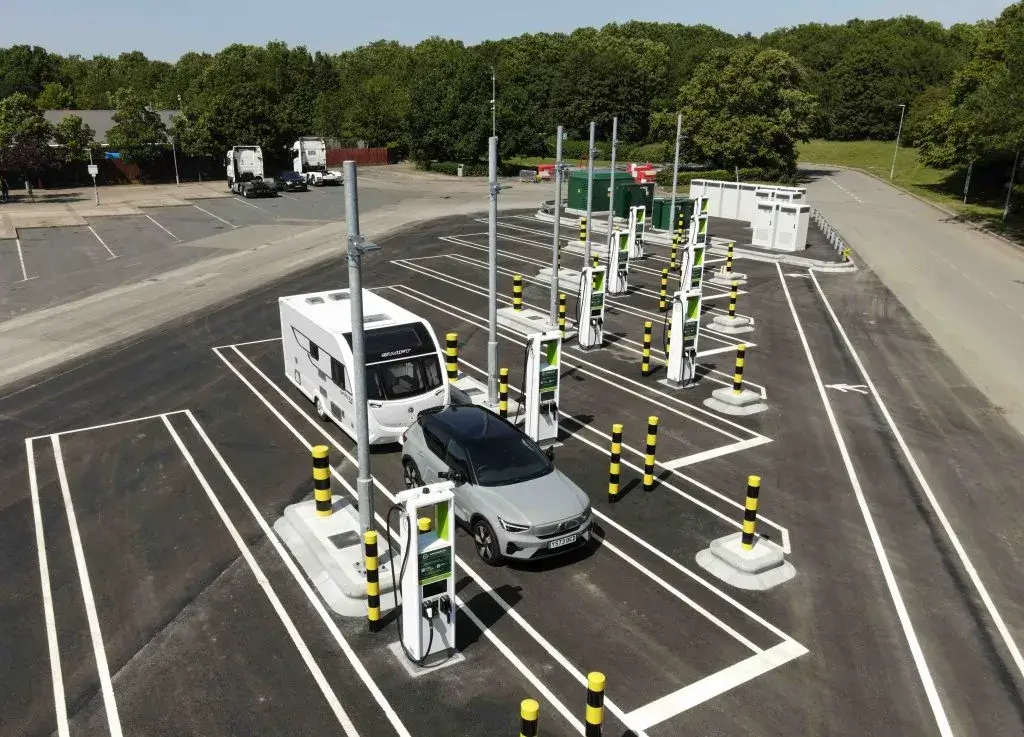
On infrastructure, Milence says around 1,800 public charging points suitable for trucks are now available along major European freight corridors. The company itself says it operates 33 charging hubs with 221 charging points across eight countries. Even so, it argues that deployment remains uneven and that the charging network still needs to scale faster to support broader market uptake.
The report also links falling charging costs to rising utilisation. As more electric trucks use public charging sites, fixed infrastructure costs can be spread across larger energy volumes, improving the economics for charge point operators and opening the way for lower per-kilowatt-hour prices for fleets. Milence presents that as one reason early adopters may benefit more over the full vehicle lifecycle as market volumes grow.


![Costs up 11%, rates up 5%: FarEye’s Suryansh Jalan on the hidden “inefficiency tax” in Europe’s last mile [INTERVIEW]](https://cdn-trans.info/uploads/2026/10/264940df8e8870b74281e69aeac-1024x769.webp)