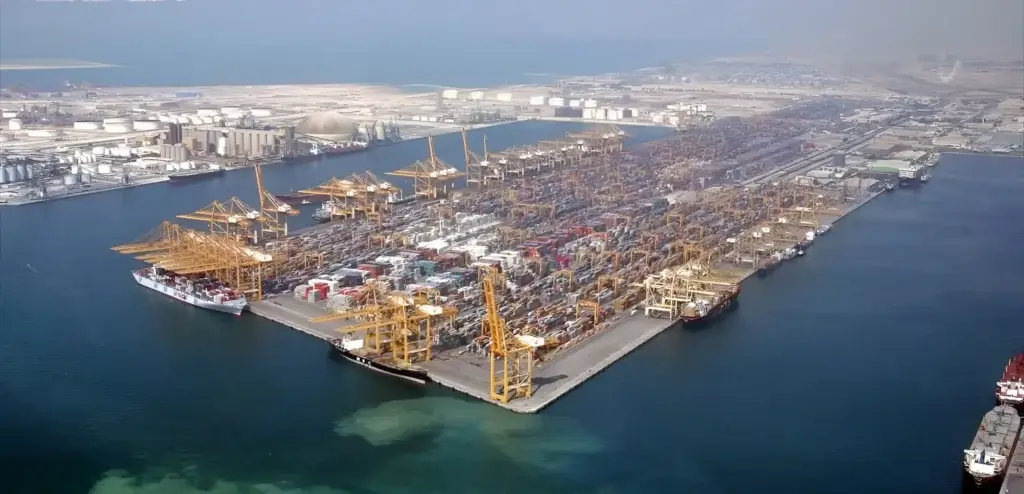
According to the report, average daily ship transits through the strait fell from 129 between 1 and 27 February to just 6 between 1 and 29 March. UNCTAD describes the route as “practically closed” after the military escalation at the end of February.
The Strait of Hormuz is one of the world’s most important arteries of energy-related trade, and UNCTAD says the disruption is hitting a significant share of global oil and gas supplies. The report presents the crisis first and foremost as an energy shock, with fuel prices rising sharply and the effects already spreading through production, transport and consumption.

Source: UN Trade and Development (UNCTAD), based on Clarksons Research Shipping Intelligence Network
Where the shock is spreading
UNCTAD’s oil price chart shows sharp increases across key crude benchmarks after 28 February, the date it identifies as the start of the latest military escalation. At the same time, the cost of moving oil has risen steeply. Its freight chart shows the dirty tanker index at 215 and the clean tanker index at 188, using 27 February 2026 = 100 as the baseline.
Those higher energy and shipping costs are now feeding through supply chains. UNCTAD says the result is a broader increase in production and transport costs, alongside higher inflation risk and weaker demand. The report also links the disruption to rising geopolitical uncertainty, which is weighing on trade and investment more widely.

Source: UN Trade and Development (UNCTAD)
The trade outlook has weakened sharply. UNCTAD now expects global merchandise trade growth to slow from 4.7% in 2025 to between 1.5% and 2.5% in 2026. Its forecast for world GDP growth in 2026 stands at 2.6%, with developed economies at 1.5% and developing economies at 4.1%.
The pressure point is debt
The financial strain is already visible across developing economies. Since the escalation, currencies have weakened by 2.9% in Africa, 2.3% in Latin America and the Caribbean, and 1.0% in developing Asia and Oceania, according to UNCTAD’s regional figures. External sovereign bond yields have also risen, by 0.64 percentage points in Africa, 0.36 points in Latin America and the Caribbean, and 0.70 points in developing Asia and Oceania since 27 February.
One of the starkest figures in the assessment is that 3.4 billion people live in 46 developing countries that already spend more on servicing debt than on health or education. UNCTAD says the Hormuz disruption is landing on economies that had very little room to absorb another shock even before the latest escalation.
The report calls for measures to stabilise prices, contain spillover across energy, trade and finance, and improve access to emergency funding for vulnerable countries. Among the steps it lists are emergency external financing for essential imports and debt servicing, loans from development banks, debt relief, central bank currency swaps and regional financial assistance.
UNCTAD warns that if the disruption persists, the result could be a wider cascading crisis across energy, trade and finance.