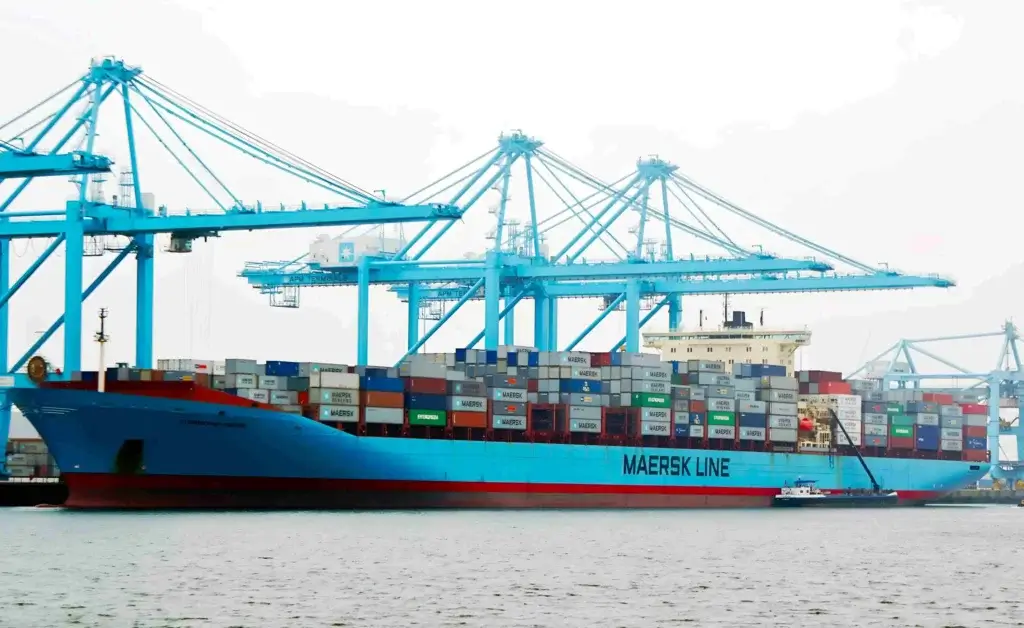
The voyage, however, underlines a central reality for global shipping in early 2026: isolated passages are not the same as a reopened route, and the Red Sea remains a corridor tested cautiously rather than trusted again.
When the US-flagged Maersk Denver transited the Bab el-Mandeb Strait and the Suez Canal in mid-January, it became the second Maersk vessel in little over a month to pass through the Red Sea. The sailing followed a similar voyage by Maersk Sebarok in December and immediately drew attention across the container sector, where most east-west services continue to avoid the region altogether.
According to Lloyd’s List Intelligence, Maersk Denver sailed through the Suez Canal on 11–12 January while operating on the carrier’s Middle East–US East Coast service. Vessel-tracking data showed that the ship temporarily switched off its Automatic Identification System while anchored at Salalah in Oman, with the signal resuming only after the vessel had cleared the Bab el-Mandeb Strait and reached waters off Sudan. Crew and cargo completed the passage without incident.
The circumstances closely mirrored those of the December transit by Maersk Sebarok, which also sailed through the Red Sea with its AIS signal temporarily deactivated around the high-risk chokepoint. Together, the two voyages represent the only confirmed Red Sea transits by Maersk since most of the container industry diverted away from the route, following attacks on commercial vessels linked to the Yemeni Houthi movement.
Test sailings under tight control
The use of AIS during these voyages has become a focal point for industry observers. While switching off AIS is permitted under certain security conditions, it is not a standard feature of scheduled liner shipping. Its application in the Bab el-Mandeb Strait illustrates the degree to which risk in the southern Red Sea is still being managed tactically, rather than absorbed into routine operations.
For carriers, this distinction matters. Tactical measures may be acceptable for individual test sailings conducted under heightened security awareness, but they are incompatible with the predictability required for regular liner services. According to Maersk, the company is following a “stepwise” approach to any potential return, with the safety of crew, cargo and vessels remaining the primary consideration. No additional Red Sea sailings have been announced.
Other carriers have adopted similar caution. French line CMA CGM has also completed individual sailings through the Suez Canal in recent weeks, again without signalling a broader shift in network strategy. The pattern across the industry suggests experimentation without commitment, rather than a coordinated move back into the Red Sea.
Trade flows adapted and not rushing back
More than two years after the first diversions, global container trade has largely adapted to operating without the Red Sea. The majority of Asia–Europe and Asia–Mediterranean services continue to route around the Cape of Good Hope, adding roughly 10–15 days to transit times and tying up vessel capacity for longer periods.
What began as an emergency response has since been built into network planning. Schedules, port rotations, equipment positioning and alliance structures have all been adjusted to accommodate longer routes. As a result, the system now carries a degree of operational inertia. Even if security conditions were to improve quickly, reversing these changes would require time, coordination and confidence that the route will remain open.
For shippers, the detour has become an accepted constraint, despite higher fuel consumption and longer lead times. For carriers, it has reshaped deployment strategies across multiple trades. In this context, a single ship passing safely through the Red Sea does not trigger an immediate reallocation of capacity, nor does it alter day-to-day routing assumptions.
Why possibility is not predictability
The key distinction highlighted by the latest Maersk sailing is the gap between what is possible and what is reliable. A vessel can pass through the Bab el-Mandeb Strait under specific conditions, supported by naval presence and additional security measures. That does not yet provide the predictability required to rebuild entire liner networks around the Red Sea and the Suez Canal.
Insurance considerations, crew welfare policies and customer commitments all depend on sustained stability rather than isolated success. While reported incidents in the region have fluctuated, there has been no prolonged period that would allow carriers to treat the corridor as consistently safe. Security assessments therefore remain voyage-specific, rather than route-wide.
Maersk’s caution also reflects broader geopolitical and trade pressures. According to reporting by Lloyd’s List, the carrier is entering 2026 facing additional headwinds, including tariffs affecting Asia–Americas trade and shifts in global sourcing patterns. In that environment, reopening the Red Sea is only one variable among many shaping network decisions.
Earlier coverage: the Red Sea crisis
Red Sea routes may reopen in 2026, but the real shock could hit freight rates
Gemini won’t return to Red Sea, Maersk might
How up to 2.1 million TEU could flood Europe if the Suez route re‑opens
UN: Global shipping faces weak growth in 2025 as rerouting, costs and new rules reshape trade