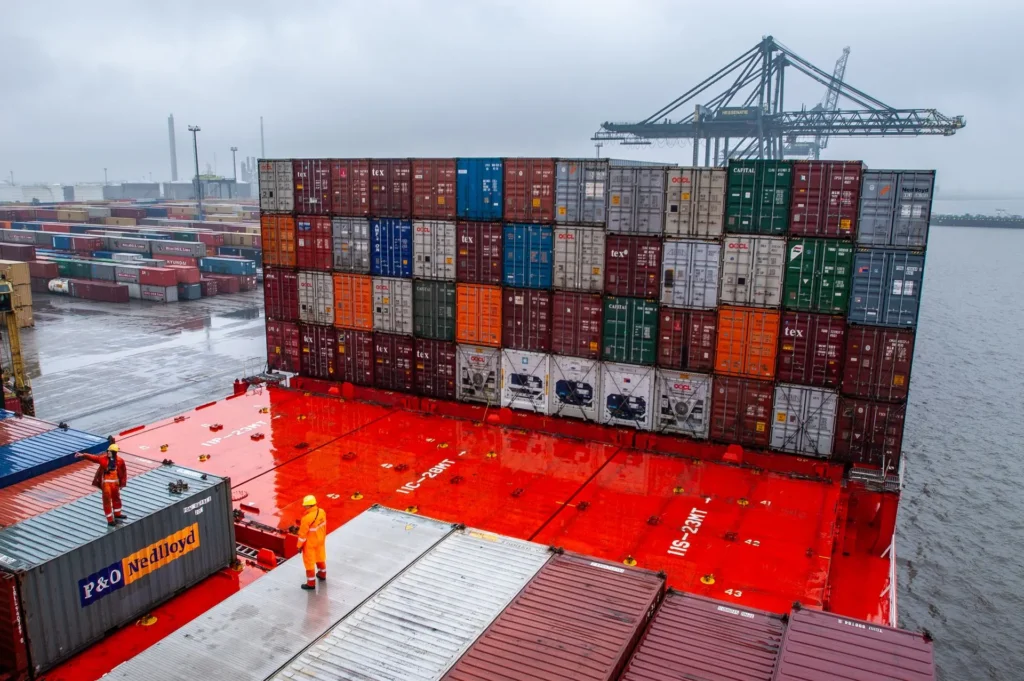
The Justice Department’s indictment targets the boxes themselves, not ocean freight rates. But the distinction is difficult to ignore: container shortages were a defining bottleneck of 2020–2022, and prosecutors allege the manufacturers restricted output at a time when global supply chains were already under severe pressure.
The four defendants — Singamas Container Holdings, CIMC (China International Marine Containers Group), Shanghai Universal Logistics Equipment, also known as Dong Fang International Containers, and CXIC Group Containers — together produced around 95% of the world’s standard dry containers, according to the US Department of Justice.
The case therefore puts renewed scrutiny on a highly concentrated part of the container shipping supply chain: the manufacturing of the standard dry boxes used to move goods by sea, rail and road.
What prosecutors allege
The alleged conspiracy ran from November 2019 to at least January 2024, covering the Covid disruption period and continuing well beyond it. The targets were standard dry containers, with affected customers said to include container lessors, shipping lines and logistics companies in the US, Europe, China and other markets.
The DOJ alleges the cartel operated with unusual rigour. Participants allegedly agreed to cap production shifts and operating hours on dry-container lines. More strikingly, prosecutors claim 87 surveillance cameras were installed across 49 production lines to monitor compliance. A penalty fund was also allegedly created to punish any participant that broke ranks.
Companies also allegedly agreed not to build new factories, exchanged commercially sensitive information, and from September 2022 to November 2023 set explicit limits on total output volumes.
The financial picture
The numbers in the indictment are striking. Container prices roughly doubled between 2019 and 2021, according to the DOJ. CIMC’s container manufacturing profits allegedly rose from $19.8 million in 2019 to $288 million in 2020 and $1.75 billion in 2021. Singamas allegedly swung from a $110 million loss in 2019 to a $186.8 million profit by 2021.
For context, Drewry reported in August 2021 that dry freight container prices had reached historic highs after doubling over the previous year. UNCTAD’s 2021 Review of Maritime Transport also linked container shortages and port congestion to record freight rates on Asia–Europe and transpacific trades.
The US case does not allege that container manufacturers fixed freight rates charged by shipping lines. Instead, it focuses on the supply and price of the equipment that carriers, lessors, forwarders and cargo owners relied on throughout the disruption.
Where things stand
One executive, Vick Nam Hing Ma, a marketing director at Singamas, was arrested in France on 14 April 2026 and faces extradition proceedings. Six other named executives remain at large.
Individual defendants face up to 10 years in prison and $1 million in fines if convicted. Corporate penalties are capped at $100 million, though that ceiling can rise if twice the gain from the offence or twice the losses suffered by victims exceed that amount.
The Justice Department stressed that the indictment contains allegations only and that all defendants are presumed innocent unless proven guilty.