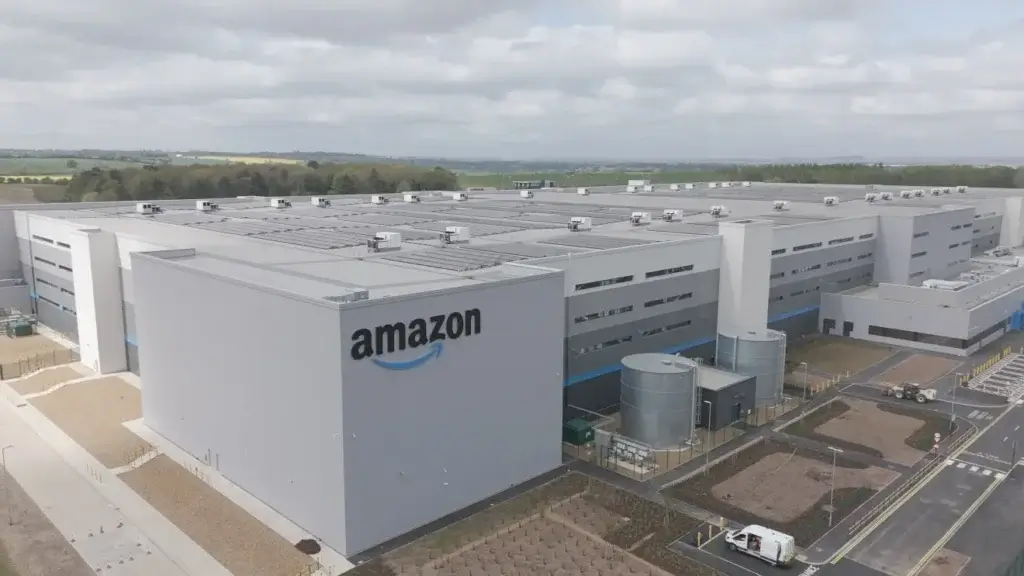

Amazon announced the investment at its Delivering the Future EMEA event at its LCY3 fulfilment centre in Dartford, which Amazon describes as its most speed-sensitive fulfilment centre globally. The site was used to showcase new automation systems intended to move goods more quickly through fulfilment and delivery operations.
A central part of the announcement is the next generation of Amazon’s autonomous mobile robot Proteus. According to Reuters, the current version of Proteus is already used at 25 sites in the United States, where it operates in dock areas and moves carts weighing up to almost 400 kg.
The upgraded version is due to be deployed in Europe in the first half of 2027. Amazon says the new Proteus will be able to respond to natural-language instructions, decide task priorities, plan routes and operate across a wider area of fulfilment and delivery centres, rather than being limited to dock areas.
Amazon also presented STARK, a robotic tote-handling system first piloted in Barcelona. The company plans to roll it out to 15 European sites by 2027. Another system, Vulcan, is described by Amazon as its first robot with a sense of touch and is also being prepared for wider operational use.
For logistics operators, the announcement points to a further tightening of the link between warehouse automation and delivery speed. Amazon is not only adding fulfilment capacity, but also changing the internal handling process inside its sites, with robots intended to reduce manual movement, shorten processing times and support denser delivery schedules.
The company is also expanding its rapid-delivery network. Amazon says it will add more than 25 sub-same-day delivery locations across Europe this year, including in the UK and Germany. These sites are designed to place stock closer to customers and support deliveries within hours rather than the next day.
Amazon is also expanding Amazon Now, its ultra-fast delivery service for everyday essentials and groceries. In the UK, the service is already available in parts of London and is due to be extended to Manchester and Birmingham this year.
The investment comes as major e-commerce and parcel networks face growing pressure to combine shorter delivery windows with lower unit costs. For carriers, fulfilment providers and last-mile operators, Amazon’s latest move adds to the competitive pressure around urban stockholding, micro-fulfilment, automation and same-day delivery capability.
Amazon says the wider programme will create 25,000 additional jobs in Europe. However, from a logistics perspective, the more important development is the scale of capital being directed into a faster and more automated fulfilment model, with European warehouses set to become a more prominent testing ground for robotics-led parcel and grocery distribution.